How to evaluate and select rail grinding companies: certifications, third-party test reports, field trial data and the red flags to avoid - with a RailwayCare checklist.
Choosing a rail grinding company is one of the highest-leverage decisions in track maintenance. A competent partner extends rail life, keeps quality records defensible and lowers cost per pass-km; a wrong choice means rework, overheated rails, wasted night windows and eventually premature rail replacement. This guide gives track engineers and procurement teams a practical evaluation framework - what to check, which documents to ask for, which numbers matter, and the red flags that should end the conversation.
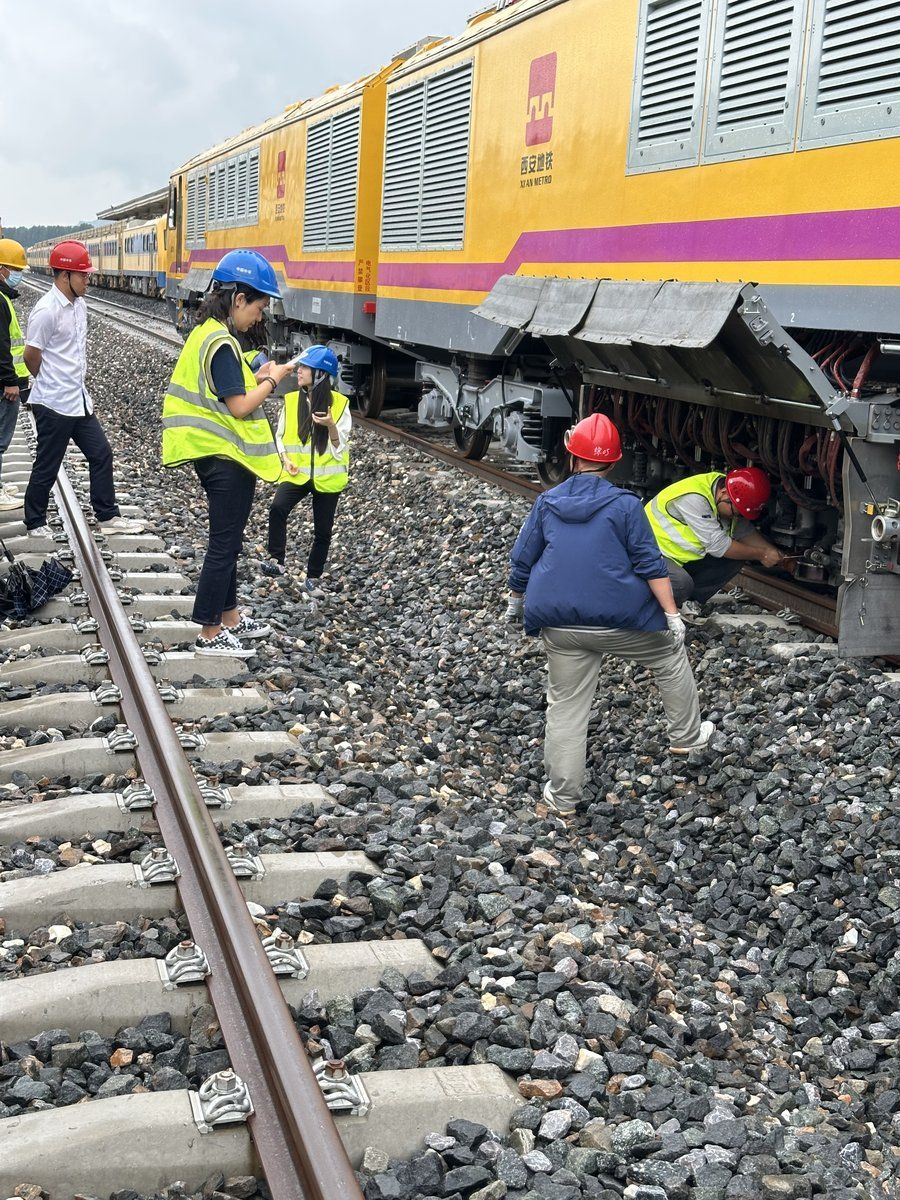
A rail grinding train in service – evaluate the company behind the machines that run your line.
Why the Choice of Supplier Matters More Than the Price
Rail grinding is precision metal removal on an asset that costs hundreds of dollars per metre to replace. The difference between a good and a poor grinding wheel or service is not cosmetic - it shows up in measurable form:
Rework and rejection: a section that fails acceptance (Ra above 10 µm, continuous blue bands, GQI below 70) must be ground again, doubling its cost.
Rail damage: overheating during grinding creates blue bands and can alter the rail steel microstructure, shortening rail life instead of extending it.
Lost night windows: a wheel that needs 4-6 passes to clear damage occupies the track twice as long as one that clears it in 2-3.
Inconsistent quality: batch-to-batch variation means your acceptance data from last year no longer holds this year.
None of these appear on a price list. That is why the selection process has to go deeper than comparing quotations.
What a Serious Rail Grinding Company Should Show You
Before any trial, a credible supplier should be able to produce five things without hesitation. If any are missing, ask why.
1. Certifications and qualifications - not just ISO 9001, but evidence their product is qualified for railway use: product certification, technical review by an independent railway institute, and references from railways that have formally accepted the product.
2. Third-party test reports - from an independent testing body, not the supplier's own lab. Look for the standards used and the measured values.
3. Field trial data - side-by-side or service data from real lines: pass-km per wheel or per mm of wear, passes to clear typical defects, surface temperature, roughness achieved.
4. Machine compatibility - a clear list of the grinding trains and hand machines the product fits, with dimensions, speed ratings and mounting details.
5. Production and quality control - where the product is made, capacity, and how consistency is assured.
Certifications and Railway Qualification: the Non-Negotiables
Railway supply is not a commodity market: components that touch the rail are qualified, reviewed and audited. When evaluating a supplier, verify the following layers rather than accepting a general ISO certificate at face value:
Management system: ISO 9001 quality management and ISO 45001 occupational health and safety are the baseline - in RailwayCare's case, certificates USA24Q41620R4M (ISO 9001:2015) and valid through 2027 and 2029 respectively.
Independent railway review: China's China Academy of Railway Sciences issued RailwayCare a technical review certificate (TKTJ-19-0007-ST) covering G1/G2 grinding train wheels and other products, valid to February 2027.
Product certification: RailwayCare received CRCC product certification in 2011 for grinding train wheels, hand-machine wheels and cut-off wheels - CRCC being the certification body for China's railway industry.
Formal acceptance by operating railways: PGM-48 wheels (2007), PGM-96C wheels (2010) and GMC-96B wheels (2013) were each formally appraised and accepted by regional railway bureaus.
Standard participation: RailwayCare helped draft JB/T 11431, the Chinese industry standard for rail grinding wheels - a supplier that helps write the standard tends to meet it.
Do not stop at the certificate numbers - verify validity and scope. A certificate covering 'grinding wheels up to 80 m/s' may or may not cover the 260×90×154 mm train wheel you actually need.
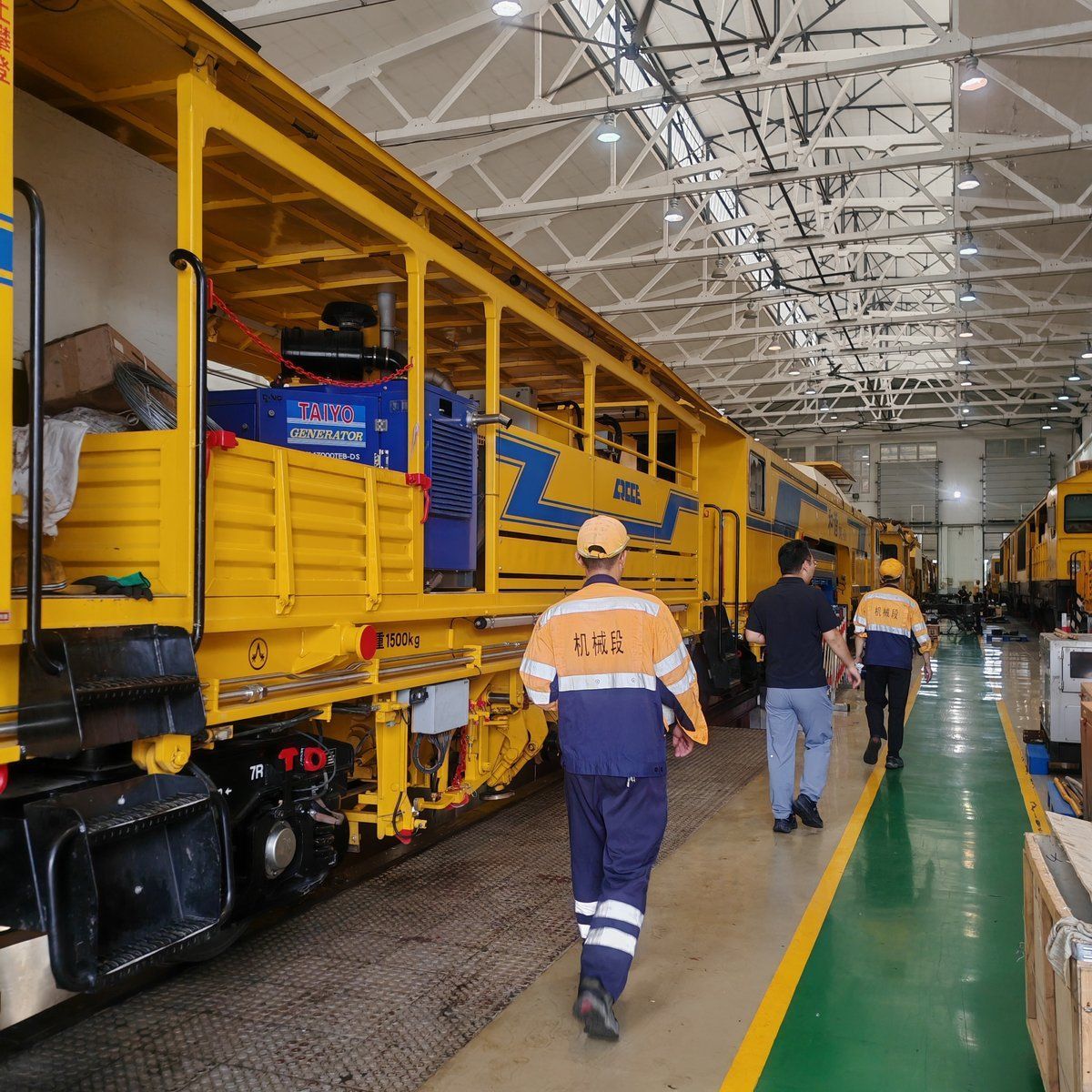
Grinding equipment and production on site – verify capacity and quality control where it happens.
Ask for Third-Party Test Reports, Not Brochures
Every supplier has a brochure. Serious suppliers also have third-party test reports. The difference is auditable evidence. When you review a test report, look at four things:
Who tested: an independent body. RailwayCare's wheels have been tested by the National Quality Supervision and Inspection Centre for Abrasives (China 'Sanmosuo') and by the China Academy of Railway Sciences - not by its own laboratory.
Against which standard: the report should cite a current standard. RailwayCare's 2024 report cites JB/T 11431-2020 (the current edition of the rail grinding wheel standard) and GB 2494-2014.
The measured values, not just a 'pass': in the 2024 report, the G1b wheel showed an unbalance of 21 g (limit 39 g), ran at the safe-speed test of 4,775 r/min for 30 s without fracture, and survived the burst-speed test at 6,354 r/min without fracture.
Real margin over the requirement: in the 2020 CARS tests, wheel wear (work removal) exceeded the Q/CR 1-2014 technical requirement by 1.4-2.6 times across G1/G2/G3/G6 wheels - not 'just above' the line, but with real margin.
A supplier that cannot produce an independent report for the specific product you are buying is asking you to accept risk on faith.
Demand Field Trial Numbers: Pass-km per Wheel, Passes to Clear
Certificates prove the product is safe and conforms; field data proves it works in service. Ask the supplier for numbers measured on real track - and compare them on a like-for-like basis:
Pass-km per wheel: how many pass-kilometres one wheel delivers before replacement. In RailwayCare's field trials, Molaton wheels achieved 100-150 pass-km per wheel versus 50-60 for typical imported wheels in laboratory simulation at identical power and speed, and lasted 1.5 times longer than the Norton wheel in a half-train comparison on the Liuzhou GMC-96X.
Pass-km per mm of wheel wear: a sharper indicator of efficiency. Molaton recorded 4.28 pass-km/mm versus 3.27 for the incumbent wheel on the Hefei-Wuhan high-speed line (214 pass-km per wheel), 4.98 pass-km/mm over 172.8 pass-km on the Shuohuang heavy-haul line, and 5.7 pass-km/mm over 145 pass-km on the Yiyang line.
Passes to clear damage: on the GMC-96X, Molaton wheels removed typical damage in 2-3 passes where the comparison wheel needed 4-6 - half the machine time and night-window occupation.
Surface quality achieved: after grinding, the rail measured Ra 7.13-7.25 µm in RailwayCare trials; in the 2026 Loram-machine test at Jiangmen, roughness across all ground rails was 1.05-9.0 µm (mostly 2-4 µm) with no blue bands.
Ask also how the data was collected - who measured, with what instrument, on what rail type and machine. Numbers without context are marketing; numbers with context are engineering.
Check Machine Compatibility and Production Capability
A rail grinding company only helps you if its products fit your machines and its production can support your demand. Verify three things:
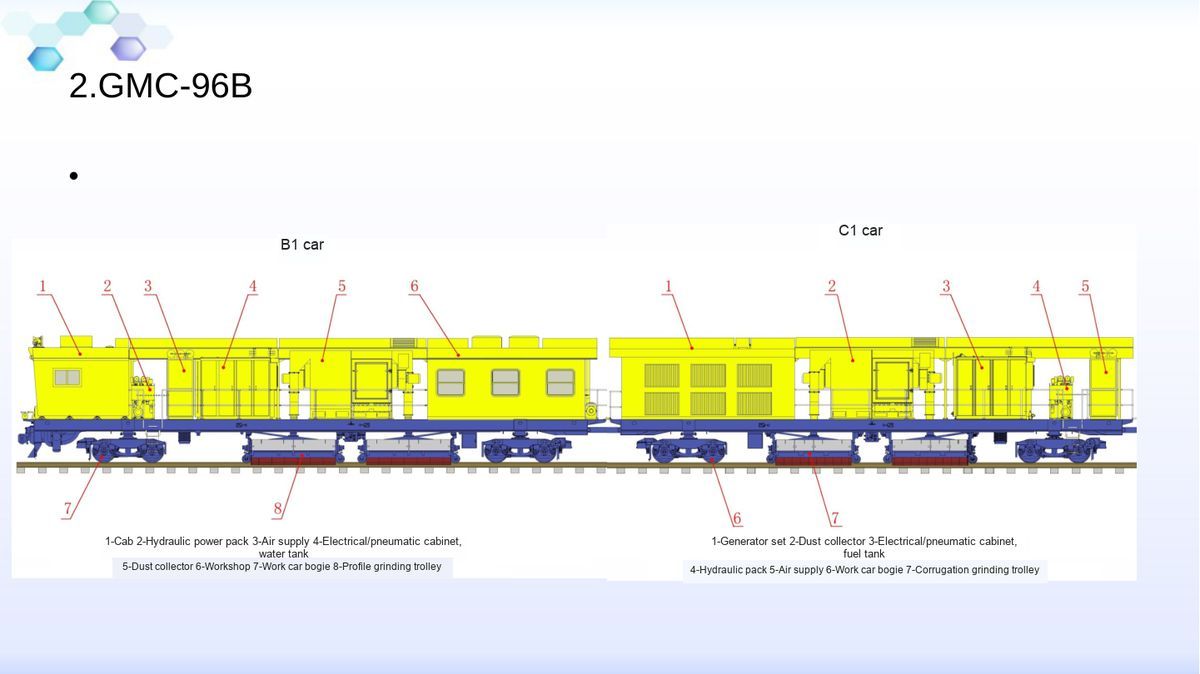
Coverage of your fleet: grinding train wheels (PGM-48/96C at 260×90×154 mm, Speno GMC16A 350 mm series, GMC96B 180×105×90 mm, Loram 250×75×150 mm), switch-grinder wheels (RGH20C 280×25.5×116 mm and 150 mm series) and hand-machine wheels (Geismar/Robel 125-250 mm) - ideally one supplier covers all, so you maintain one specification system.
Safety rating and materials: rated operating speed (50 m/s for train wheels), abrasive type (zirconia-alumina), and construction details (resin bond with glass-fibre wrapping). The raw materials matter - RailwayCare uses Saint-Gobain zirconia-alumina and resin from SI Group.
Production capacity and quality system: how many wheels per year, and how consistency is controlled. RailwayCare produces 500,000 wheels per year under ISO 9001/45001, and operates a dedicated rail grinding wheel laboratory with Wuhan University of Technology.
Fig. 1 – A GMC-96B-class grinding train: supplier products must fit the machines your railway actually runs.
A 10-Point Evaluation Checklist
Use this as a scorecard when comparing rail grinding companies:
1. Does the supplier hold valid ISO 9001 and ISO 45001 certificates?
2. Is the specific product independently qualified for railway use (not just 'ISO certified')?
3. Can they show third-party test reports against a current standard (e.g. JB/T 11431-2020)?
4. Do the reports show real margin over the requirement, not a bare pass?
5. Do they publish field data - pass-km per wheel, pass-km per mm, passes to clear?
6. Was the field data measured side-by-side against a benchmark wheel on the same train?
7. Do their products cover your full fleet (train wheels, switch wheels, hand-machine wheels)?
8. What are the rated speed, abrasive and safety construction of the exact wheel you need?
9. Can they support production volume and hold consistent quality batch to batch?
10. Do they provide engineering support - wheel selection, grinding parameters, angle plans - not just deliveries?
Score each criterion; eliminate any supplier that fails 1, 2 or 3. The rest can be compared on engineering merit and total cost per pass-km rather than unit price.
Red Flags That Should End the Conversation
No independent test report, or a report from the supplier's own laboratory only.
Field claims without context: 'lasts very long' but no pass-km, no machine, no rail type, no measurement method.
Certificates that do not cover the product you are buying (e.g. general company ISO, no railway qualification).
No compatibility list - 'we make grinding wheels' but cannot tell you which machines each wheel fits.
Price-only selling, with no engineering conversation about your rail type, defects and grinding strategy.
If you see two or more of these, the likely cost of the relationship exceeds any saving on the unit price.
Why RailwayCare Passes Its Own Checklist
RailwayCare (Wuhan Huatie Ruijie Rail Transit Technology Co., Ltd.) supplies Molaton grinding wheels to railways, contractors and distributors worldwide. Measured against the framework above:
Qualified: ISO 9001:2015 and ISO 45001:2018; CARS technical review TKTJ-19-0007-ST valid to 2027; CRCC certification since 2011; regional bureau acceptance for PGM-48, PGM-96C and GMC-96B wheels; co-drafter of JB/T 11431.
Independently tested: National Abrasives QC Centre report (2024) against JB/T 11431-2020 - unbalance 21 g, 6,354 r/min burst test without fracture; CARS tests with wheel wear 1.4-2.6 times the Q/CR 1-2014 requirement.
Field-proven: 1.5× wheel life vs Norton on the Liuzhou GMC-96X; 214 pass-km per wheel on the Hefei-Wuhan HSR; 4.98-5.7 pass-km/mm on Shuohuang and Yiyang heavy-haul; 90/100 acceptance on Chengdu Metro; best-in-test result on the 2026 Loram-machine comparison.
Full fleet coverage: PGM-48/96C, RGH20C, Speno GMC16A/96B, Loram, and Geismar/Robel hand machines, all at 50 m/s rated speed with zirconia-alumina construction.
Capacity and R&D: 500,000 wheels per year; dedicated rail grinding wheel laboratory with Wuhan University of Technology; Saint-Gobain and SI Group raw materials.
Talk to us and we will give you the same documents we list above - certificates, test reports, field data and machine lists - before you commit to a trial.
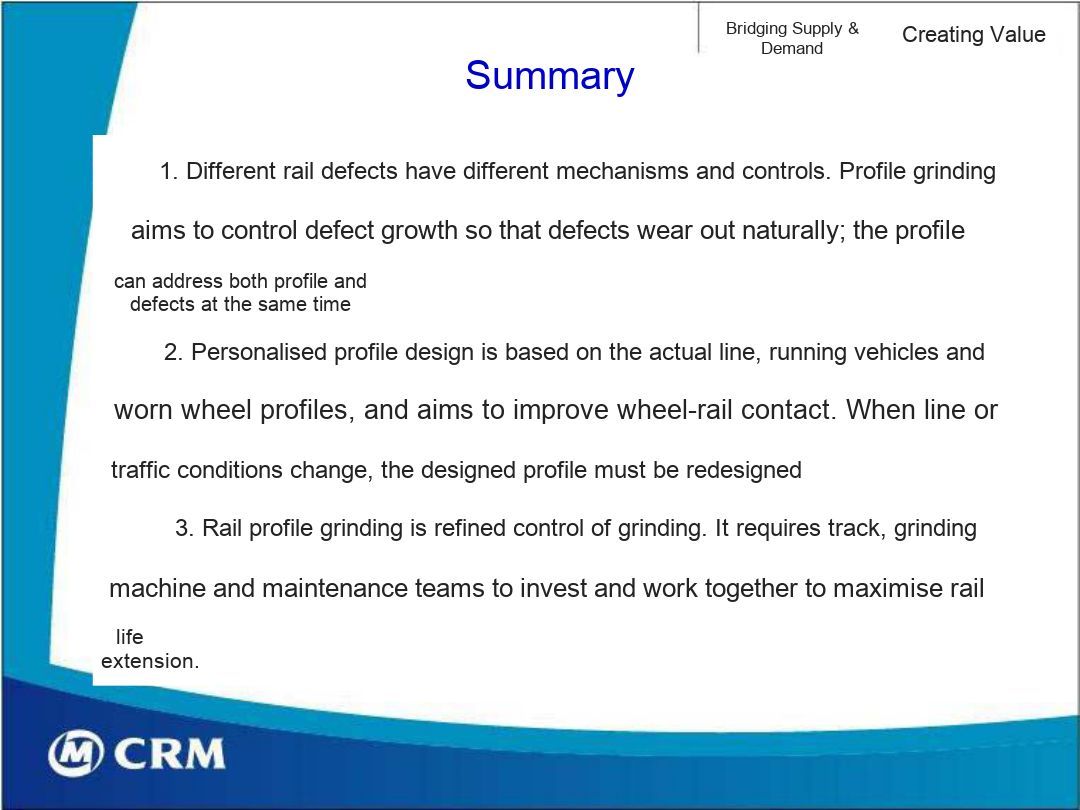
Fig. 2 – Rail grinding strategy thinking: different defects need different profiles and processes – the engineering depth a serious supplier should bring.
FAQ - Rail Grinding Companies
What do rail grinding companies actually do?
Rail grinding companies supply the wheels, machines, services or full grinding programmes used to restore and maintain rail heads. Some are service contractors that run grinding trains; others, like RailwayCare, manufacture the grinding wheels used on train, switch and hand-held machines and support operators with wheel selection and grinding parameters.
How do I verify a rail grinding supplier's quality claims?
Ask for three things: valid ISO 9001/45001 certificates; independent third-party test reports against a current standard (e.g. JB/T 11431-2020) showing measured values with real margin; and field data with context - pass-km per wheel, pass-km per mm of wear, machine and rail type, and who did the measurement.
Is the cheapest rail grinding company the best value?
Almost never. Grinding cost should be measured per pass-km, not per wheel or per metre of service. A wheel that lasts 1.5 times longer and clears defects in half the passes is cheaper in total even at a higher piece price, because it cuts machine time, night-window occupation and rework risk.
Should I choose a supplier that covers all my machines?
It simplifies specification, inventory and quality control if one supplier covers your grinding train wheels, switch wheels and hand-machine wheels with a consistent specification system. If you need multiple suppliers, make sure each can document compatibility for the exact machines you run.
What is a reasonable first step with a new rail grinding company?
A supervised trial on a representative section, with agreed acceptance criteria (Ra ≤ 10 µm, no blue bands, GQI ≥ 85) and side-by-side comparison if possible. Agree beforehand how pass-km, wheel wear and surface quality will be measured, so the trial produces numbers you can defend.
Final Thoughts
The right rail grinding company is a maintenance partner, not a line item. Certifications show they are qualified, test reports show they are honest, field data shows they work, and engineering support shows they understand your line. Score suppliers against the checklist, run a supervised side-by-side trial, and measure the result in pass-km and GQI - not in unit price.
Tell us your rail type, machine fleet and line conditions - we will send our certificates, third-party test reports and field data, and help you set up a supervised trial with acceptance criteria you define.
Whether you are evaluating rail grinding companies, need grinding wheels for your fleet, or want a second opinion on your grinding programme, our engineers are ready to help. Reach us by any channel below:
Technical consultation:Contact our team or email your rail type, machine fleet and line conditions for a recommendation.
RailwayCare (Wuhan Huatie Ruijie Rail Transit Technology Co., Ltd.) – your professional partner in rail grinding, with Molaton grinding wheels field-proven on high-speed, heavy-haul and metro lines since 2004.