Which grinding wheel suits UIC60 and 60kg/m rail profile grinding?
- Share
- Issue Time
- Oct 3,2026
Which grinding wheel suits UIC60 and 60kg/m rail profile grinding?
UIC60 and 60 kg/m rail take the same wheel class. Both belong to the 60 kg/m nominal head family — UIC60 is the European designation, 60 kg/m is the Chinese one, and 60N is the adapted profile now specified for main lines — and on all of them the wheel is chosen by three things, none of which is the profile name: (1) the grinding head (bore, diameter band and rated speed); (2) the pass plan (preventive or corrective, and how much metal per pass); (3) the target profile and its acceptance limits. For 60 kg/m main-line grinding the workhorse sizes are 260×90×154 mm for PGM-48/96C class trains, 250×75×150 mm for GMC96B and Speno GMC-48/96 class, 260×83×154 mm for Loram C44/MFS and 180×105×90 mm for turnout units. All are zirconia alumina, resin bonded, glass-fibre reinforced and rated 50 m/s.
One head family, three profile names
The confusion in this question comes from treating three different naming systems as three different jobs.
| Designation | What it is | What it changes for the wheel |
|---|---|---|
| UIC60 | The European 60 kg/m rail section used across Continental and UK networks | Nothing about the consumable — the head is the same weight class as 60 kg/m |
| 60 kg/m | The Chinese 60 kg/m rail section, standardised for 43-75 kg/m rail under TB/T 2344.1 | Nothing — same grinding duty |
| 60N | The adapted 60 kg/m profile; rail-use rules for main lines (Q/CR 583) call for 60N and 75N profiles on plain line outside turnouts | Changes the target profile template, therefore the pass plan — not the wheel |
Two practical consequences follow. First, a wheel store does not need a “UIC60 wheel” and a “60N wheel”; it needs wheels matched to the grinding heads on site. Second, profile matters in the other direction too: where a 60 kg/m profile is not adapted to the track it runs on, abnormal head wear and lipping are reported — which is exactly the damage profile grinding exists to remove. Turnout rail is a separate section again, covered by TB/T 2344.2, and rails connected to a turnout should match the rail type and profile inside it.
Selecting the wheel for a 60 kg/m job
| Step | What to establish | Why it decides the wheel |
|---|---|---|
| 1. Grinding head | Bore and fixing, diameter band, rated spindle speed | Physical fit. A 154 mm bore head cannot take an M20 portable wheel at any profile |
| 2. Machine class | Production train, light turnout unit or portable grinder | Sets the diameter band: 230-280 mm on trains, 150-180 mm on light turnout units, 125-150 mm on portables |
| 3. Pass plan | Preventive, pre-grind or corrective; metal per pass | Decides how hard the wheel works each pass, and therefore grade and life |
| 4. Target profile | UIC60, 60 kg/m or 60N template; which zones carry the tolerance | Decides how many passes and which grinding angles — the wheel size stays |
| 5. Acceptance | GQI, Ra, straightedge, blueing, depth limit | Confirms the plan worked; if it fails, change the plan before the wheel |
The sizes that cover the great majority of 60 kg/m profile work:
| Wheel | Typical machine | Note |
|---|---|---|
| 260×90×154 mm | Harsco PGM-48/PGM-96C, CRRC Baoji GMC-48, Jinying GMC-96 | ZA F16 Y5B, 9 kg, 50 m/s — the mainstream main-line size — 260×90×154 |
| 250×75×150 mm | Speno GMC-48/GMC-96 and CRRC Taiyuan class (GMC96B) | ZA F16 Y5B, 7.48 kg, 50 m/s — 250×75×150 |
| 260×83×154 mm | Loram C44/MFS | Aluminium body, ZA, glass-fibre reinforced, 50 m/s — 260×83×154 |
| 180×105×90 mm | Speno GMC16A turnout units | Turnout work on 60 kg/m track — 180×105×90 |
Speeds always come from the diameter, not the catalogue: at 50 m/s the rpm is 954,930 ÷ D with D in millimetres, so 260 mm is about 3,673 rpm and 250 mm about 3,820 rpm. That is why marked speeds read 3,630 and 3,280 rpm on those two wheels. Full arithmetic is in maximum operating speed for a rail grinding wheel, and the meaning of each number on the label is in what a 260×90×154 mm specification means.
Holding the profile: what the 60 kg/m job is measured against
Profile grinding on 60 kg/m rail is judged by how closely the finished shape matches the design profile. The Grinding Quality Index scores that fit from 0 to 100 across four zones of the rail head:
| Zone | Tolerance |
|---|---|
| Zone 1 — rail head centre | +0.2 / −0.4 mm |
| Zones 2, 3, 4 | ±0.2 mm |
| Single profile verdict | Excellent GQI ≥ 85, acceptable ≥ 70, reject below 70 |
| Section verdict | Excellent GQI ≥ 85 with standard deviation ≤ 8; acceptable GQI ≥ 70 with standard deviation ≤ 10 |
The depth targets sit alongside: pre-grind at least 0.2 mm, preventive grinding at least 0.1 mm, corrective grinding at least 0.2 mm at the rail head centre. And the classic acceptance limits apply throughout — no continuous blue band, no pronounced periodic wheel marks, Ra ≤ 10 μm, 0.3 mm under a 1 m straightedge, ramp not steeper than 1‰, and no more than 0.5 mm of parent metal removed.
Note how shallow the preventive figure is. On 60 kg/m main line, most of the profile work is holding a shape rather than restoring one, which is why the same wheel runs many times at a small depth instead of a few times at a large one. That is also why the wheel choice is far less sensitive to the profile name than buyers expect. If profile is being restored rather than held — after corrugation, side wear or lipping — see rail profile grinding techniques and standards.
Field result on a 60 kg/m high-speed corridor
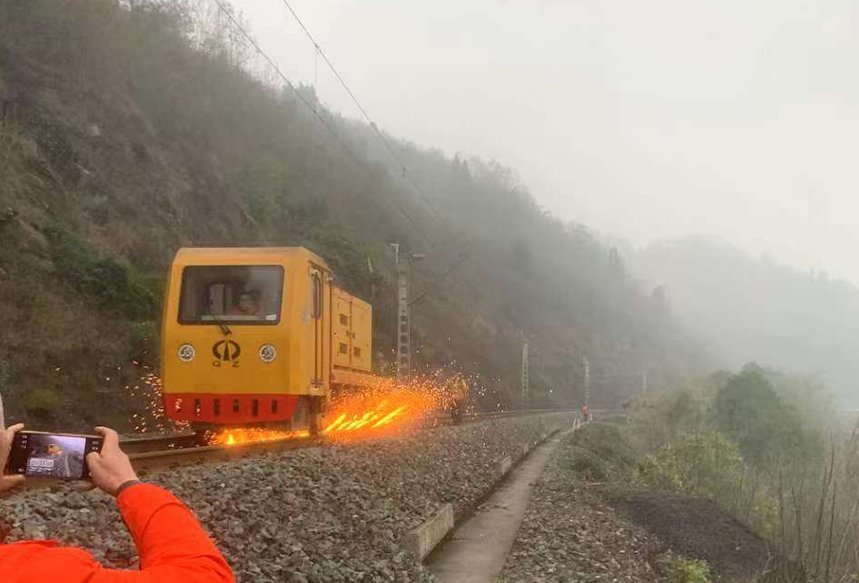
On the Hewu high-speed passenger corridor, a 260×90×154 mm wheel ran on PGM-96C-class equipment at 68% grinding power (20.4 kW), 3,600 rpm and 16 km/h:
- 4.28 pass-km per millimetre of wheel wear against 3.27 for the wheel then in use — a life ratio of 1.31×
- 214.22 pass-km averaged per wheel
- No continuous blueing, contact band centred on the rail head, and markedly less fume after sulphur-bearing material was replaced in the formulation
A wheel that holds its shape for more pass-kilometres is what keeps a 60 kg/m profile within GQI tolerance over a whole section, because every extra wheel change is a chance to shift the template. The heavy-haul counterpart — 75 kg/m rail, 4.98 pass-km per millimetre and 199 pass-km averaged — is documented in enhancing efficiency on heavy-haul lines, and the high-speed case in the Shanghai-Wuhan-Chengdu corridor study.
Our standard rail grinding wheel range covers all four sizes above; where a machine falls outside them, the custom bore and diameter route is set out in light customization solutions.
Related questions you may also ask
What does a specification like 260x90x154 mm mean? Do heavy-haul and high-speed railways need different grinding wheels? Can one rail grinding wheel fit different grinding machines? Which rail grinding wheel is best for switch and turnout grinding? More answers on rail grinder wheelsConfirm the wheel for your 60 kg/m profile job
Send Molaton your rail section and profile template (UIC60, 60 kg/m or 60N), the grinding machine and its head, and whether the job is preventive or corrective. We will confirm the Molaton size, grit and grade, and the pass depth that holds your GQI target.
Request a Profile Wheel Recommendation