Do heavy-haul and high-speed railways need different grinding wheels?
- Share
- Issue Time
- Oct 2,2026
Do heavy-haul and high-speed railways need different grinding wheels?
Yes — but the difference is in the grade and the pass plan, not in a separate wheel standard. Heavy-haul duty needs a tough, coarse wheel that keeps cutting through crushing and flange flow under high axle loads: zirconia alumina F16, resin bond with glass-fibre reinforcement, 50 m/s, in the deep-removal sizes the machine takes. High-speed duty uses the same wheel family differently: shallow passes, a tighter surface finish, and the heat kept under control so nothing is burned and no brittle white layer is left on the head. Both run resin-bond wheels rated 50 m/s, both are inspected wheel by wheel, and both are matched to the grinding head rather than to the track. What changes is removal depth per pass, wheel thickness and grade, and the acceptance limits you have to hit at the end.
Why the two duties pull the wheel in opposite directions
- The defects are not the same, so the cut is not the same. The damage mix is line-type driven. On heavy-haul lines the leading defects are crushing, flange flow and side wear, produced by very high axle loads and high traction forces. On high-speed lines the leading defects are rolling-contact fatigue, corrugation and rail indentations, produced by repeated high-speed contact rather than by extreme load. A wheel picked from the defect name alone will be wrong for one of the two.
- Heavy-haul wants metal off, and it wants it off evenly. Long arcs at high unit pressure keep the wheel loaded for kilometres at a time, so the grain must stay sharp and the wheel must hold its form. Zirconia alumina is the abrasive that does this: in our own material testing, F16 zirconia alumina measured a compressive strength of 308.0 MPa with a grinding ratio of 41.0, against 124.0 MPa and 22.4 for calcined brown alumina and 103.2 MPa and 11.9 for white alumina.
- High-speed wants the surface right, not the stock off. High-speed passes are run shallow by design — roughly 0.1 mm per pass and no more than about 3 passes in high-speed passive operation. The failure mode is not slow removal, it is burning, white layer and profile error. A wheel that forces a deeper pass to compensate is the wrong wheel for that duty.
- Heat hurts both, and it bites harder at speed. The white layer left by an overheated pass measures about 870 HV0.3 against roughly 340 HV0.3 for the parent metal. That hard, brittle layer breaks up under traffic and feeds new cracking, which is the opposite of why you ground the rail. Ground-surface temperature must finish below 150 °C with no continuous blue band. Our wheels address this in the compound itself: a hydrophobic aerogel plus N20 hollow glass microspheres to limit heat conduction into the work, and sulphur held to 0.03% or below so the pass does not generate harmful fume.
- “Harder” is not the answer on either line type. In our series tests, raising the bond content raised compressive strength but cut the stock removed: from GS-10 to GS-15, removal fell from 1.0 g to 0.2 g while the grinding ratio rose from 12.8 to 24.1. A harder wheel is more wear-resistant and less able to cut. The middle of the range is the optimum, and an over-hard choice shows up as a glazed, polished surface that operators misread as a good result.
The specification differences, side by side
| Requirement | Heavy-haul duty | High-speed duty |
|---|---|---|
| Abrasive and grit | Zirconia alumina F16 — coarse and tough, chosen for compressive strength and grinding ratio | Zirconia alumina, grade tuned for cooler cutting with the same F16-F20 grain band |
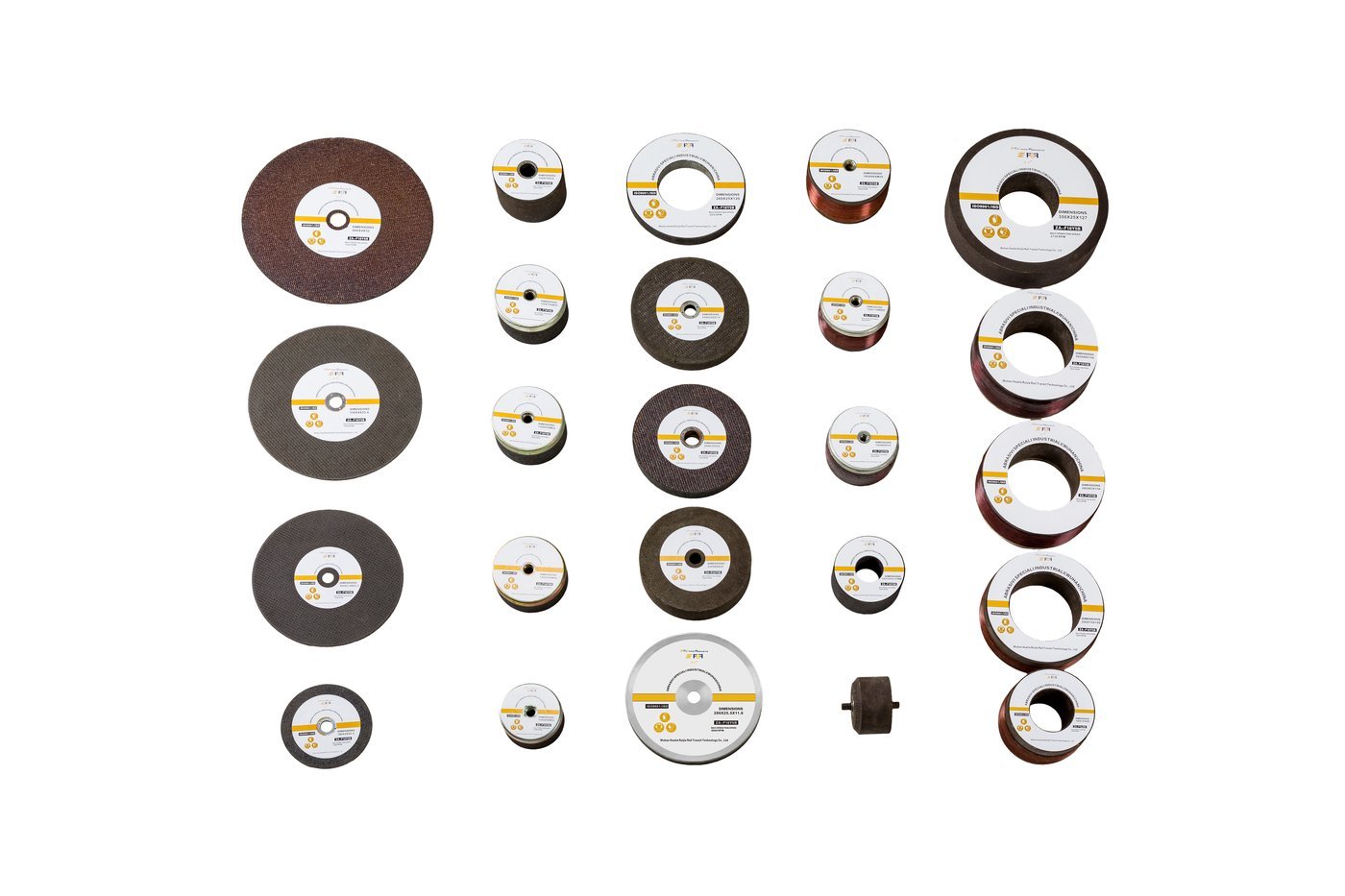
| Wheel size class | Deep-removal train wheels: 260×90×154 mm and 250×75×150 mm | Main-line train wheels plus small passive wheels in the 119-122.5 mm class for no-possession passes |
| Removal per pass | About 0.2 mm typical active removal, capped at 0.5 mm base-material removal by main-line contract limits | About 0.1 mm per pass, up to about 3 passes in passive high-speed mode |
| Pass strategy | Fewer, deeper passes inside a long possession | More, shallower passes, contact band and profile restored in the same campaign |
| Finish limits | Ra 10 µm or better, no continuous blue band, 1 m straightedge within 0.3 mm, ramp-off steeper than 1‰ | Same limits, with the added emphasis on profile conformance: GQI of 85 or better in the good band |
| Bond and reinforcement | Resin bond, glass-fibre reinforced — the bond used across every rail grinding machine in service | Identical construction; the bond must tolerate interrupted cutting on joints |
| Speed rating and balance | 50 m/s marked on the wheel; static balance to K=0.4 under Q/CR 1-2014 | Same; the marking is the limit and the machine spindle must not exceed it |
| Inspection | Appearance, mated surfaces, dimensions, static balance and rotation strength checked wheel by wheel under Q/CR 1-2014 §6.2.2 | Same regime, no reduction for smaller or faster lines |
The line that matters most is the last one. Wheel-by-wheel inspection is not a premium service reserved for heavy-haul; it is the baseline for every wheel that goes onto a grinding head, at any speed, on any network.
Which wheel class goes on which machine
| Machine doing the work | Wheel class | Catalogue size and compatible systems |
|---|---|---|
| Heavy-haul production grinding train | Heavy-duty zirconia alumina, F16, resin bond, glass-fibre reinforced, 50 m/s | 260×90×154 mm for Harsco PGM48/96C, CRRC Baoji GMC-48 and Jinying GMC-96 class machines — see the heavy-haul 260×90×154 wheel and the PGM-48/96C fitting answer |
| Main-line, metro and mixed-traffic train | Heavy-duty zirconia alumina, F16, resin bond, 50 m/s | 250×75×150 mm for Speno GMC-48/GMC-96 and CRRC Taiyuan class machines — 250×75×150 for GMC96B and main-line units |
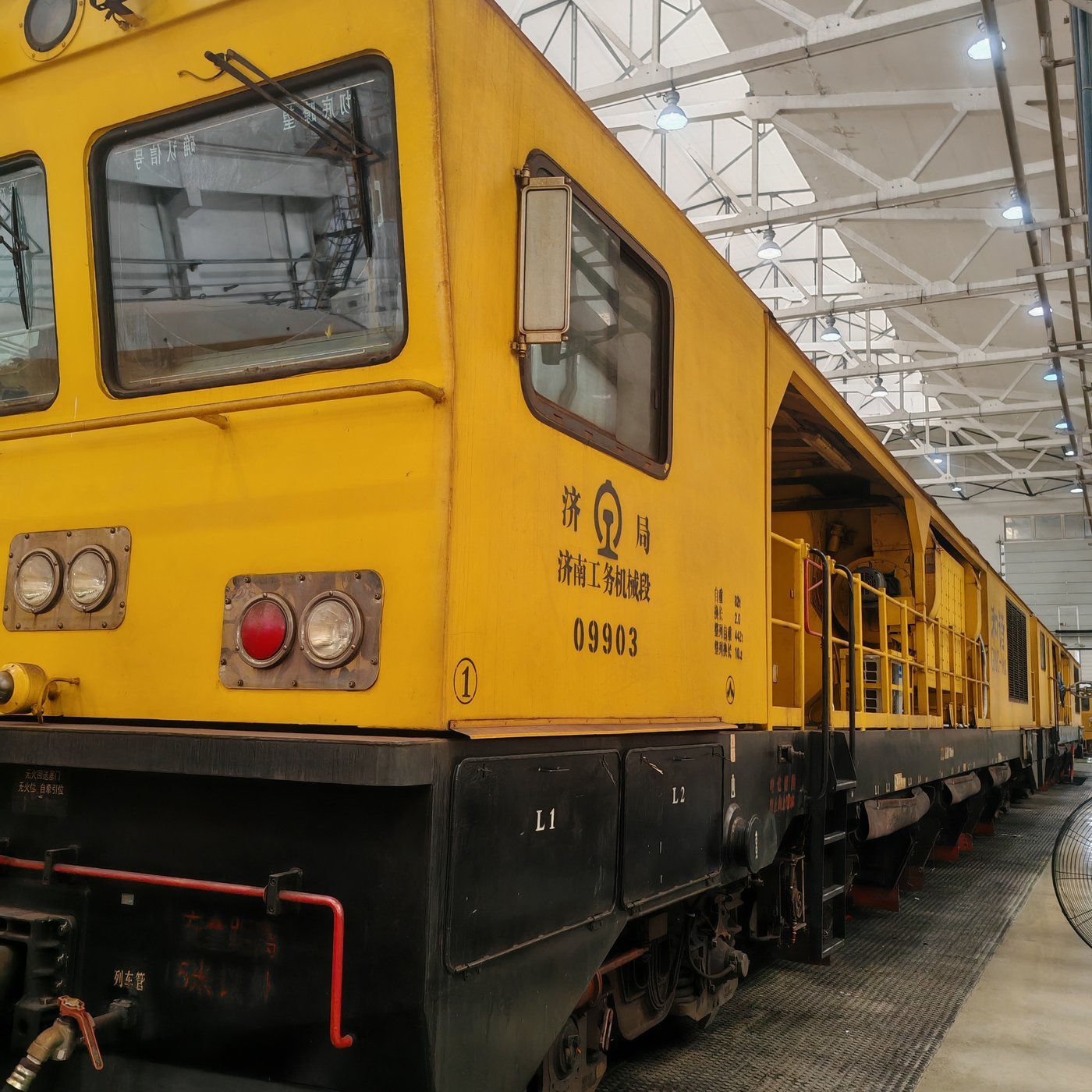
| High-speed train, main line and high-speed replacement | High-speed main-line wheel, aluminium core, zirconia alumina, glass-fibre reinforced, 50 m/s | 260×83×154 mm for Loram C44/MFS class machines — Loram C44/MFS wheel |
| High-speed passive grinding, no possession | Small passive wheel, zirconia alumina, resin bond, up to 40 m/s | Passive wheels in the 119-122.5 mm class used for light preventive passes only — see the operating parameters of high-speed passive grinding |
| Turnouts and switch units | Turnout switch-unit wheel | 180×105×90 mm for Speno GMC16A switch units — GMC16A switch-unit wheel |
Two practical notes. First, the wheel is matched to the head, not to the line: a heavy-haul network running a GMC-48 class machine takes the same 260×90×154 wheel as any other network running that machine. Second, keep the wheel families in stock by head type, not by line type — the full catalogue is on the rail grinding wheel product page, and the differences between sizes are set out in how to read a wheel specification.
The grinding cycle is part of the wheel decision
How you cut and how often you cut are one choice, not two. Chinese network practice sets preventive cycles by radius and traffic volume:
| Track condition | Preventive grinding interval | What it implies for the wheel |
|---|---|---|
| Heavy-haul and high-speed, small-radius curves | Every 30-50 million tonnes | A curve wheel accumulates pass-kilometres fastest, so wear rate per pass-kilometre dominates the budget |
| Conventional and heavy-haul tangent track, large-radius curves above about 1,200 m | Every 100 million tonnes | Long intervals between visits reward a wheel that holds its profile across many thousands of pass-kilometres |
| High-speed lines | Every 30-50 million tonnes and not more than 2 years apart | A time limit as well as a tonnage limit means the wheel must deliver a shallow, repeatable pass rather than a single deep one |
There is a threshold underneath these cycles that applies to both line types. Rolling-contact fatigue develops by ratcheting of the surface layer: micro-cracks nucleate, then initiate, then propagate, and the first two stages consume most of the fatigue life. While crack depth is still around 0.2 mm or less, a normal grinding pass removes the cracked layer completely. Past that depth the surface can be cleaned while the crack root survives. This is why a high-speed wheel is judged on consistency pass after pass, and a heavy-haul wheel on toughness across a long arc — they are protecting against different stages of the same failure.
What our own heavy-haul and high-speed programmes show
Both duty types have been measured on our wheels in service. Compare figures only between lines of similar condition:
- Shuohuang heavy-haul, half-train set — 48 wheels on the left-hand side, 15 km/h, 13.8 kW, 172.8 pass-km recorded; average wear thickness 34.67 mm, which is 4.98 pass-km per mm, averaging 199 pass-km per wheel. A single-trolley comparison in 2023 recorded 5.96 against 4.99 for the wheel then in use, about 19.4% better, with a best single wheel reaching 332.3 pass-km. Cumulative wheels fitted to date: 808. The rail on trial was 75N-U78CrV and 60-U75V, with fish-scale and film-type defects dominant — the heavy-haul case is documented in this heavy-haul efficiency case.
- Hewu high-speed line, PGM-96C, 2020 — 4.28 pass-km per mm against 3.27 for the wheel then in use, or about 1.31 times, averaging 214.22 pass-km per wheel at 68% power (20.4 kW), 3,600 rpm and 16 km/h, with no continuous burning on the finished surface. The programme sits inside the Shanghai-Wuhan-Chengdu high-speed corridor works.
- Yiyang line and Liuzhou works — 5.7 pass-km per mm and 228 pass-km average on the Yiyang line; a two-hour night possession at Liuzhou completed 18.72 pass-km with wheel wear of 20-30 mm for the composite design against 43.5-59 mm for the imported reference wheel in the same conditions.
Those numbers were produced under specific axle loads and speeds. The honest way to use them is as an expectation, not a specification: run a small set on your own line, alongside your incumbent wheel, on the same machine in the same windows, and compare in pass-kilometres rather than in calendar time.
How to decide for your own network
- Write down the duty, not the line type. Axle load, curve radius mix, defect mix and the machine you intend to use — those four decide the wheel.
- Fix the size from the head. Bore, guard clearance and catalogue diameter band first; grade and grit second. If the size is wrong nothing else compensates.
- Set the pass plan before you order. Removal per pass, number of passes, and the possession length available. On heavy-haul that usually means fewer deep passes; on high-speed, more shallow ones.
- Set the limits you will be measured against. Ra, straightedge, ramp-off, no continuous blue, and profile conformance. A wheel that meets the removal target but misses the finish target is not a saving.
- Watch the second cycle, not the first. The real verdict on a wheel arrives when the line is reground. Early corrugation or fatigue return means the profile work was incomplete or the grade was wrong.
For the underlying techniques see rail profile grinding techniques and standards. On the two failure modes that separate the duties: rolling contact fatigue and its grinding mitigation covers the high-speed threat, and burning prevention covers the heat limit both duties share. For how imported and domestic wheels actually compare on measured performance, see five key performance indicators compared.
Related questions you may also ask
What is a high speed grinding train? Which wheel fits CRRC and Harsco grinding trains? What wheel types does Molaton offer for different railways? Portable rail grinder vs full-size grinding train What is rail grinding: complete guide for track operators More answers on rail grinder wheelsMatch the wheel to the duty, not to the label
Tell Molaton your axle load, curve mix, defect mix and the machine you run. We will come back with the Molaton wheel size and grade for that duty, plus the pass plan that meets your finish limits.
Request a Heavy-Haul or High-Speed Wheel Recommendation