Vibration during rail grinding: is it the wheel balance or the machine?
- Share
- Issue Time
- Sep 28,2026
Vibration during rail grinding: is it the wheel balance or the machine?
Separate the two with one swap test. If the vibration follows the wheel to another grinding head, the wheel is the source — balance, run-out or how it is seated. If it stays on the same head when a known-good wheel is fitted, the machine is the source — spindle bearing, chuck and flange condition, actuator pressure or head geometry. The wheel side is bounded by numbers you can hold in your hand: static balance coefficient K = 0.4 with unbalance not exceeding 0.4 × √M (M = wheel mass in grams), permissible unbalance measured to GB/T 2492 and ISO 6103, and run-out held to ISO 13942. The machine side has no such number — it shows up only as abnormal vibration, rising contact pressure or unstable power.
The swap test and how to read it
- Mark the suspect wheel and note which head it runs on, at which angle and which power setting.
- Stop, move that wheel to a different grinding head, and fit a wheel with a clean balance and run-out record on the original head.
- Run the same duty again at the same power and travel speed.
- Vibration follows the wheel → wheel fault. Vibration stays on the head → machine fault. Vibration disappears → neither; the fault was in the mounting and it was corrected by remounting.
| What you observe | Most likely source | Next check |
|---|---|---|
| Vibration rises with speed, roughly with the square of it | Wheel unbalance | Wheel balance record; re-verify unbalance |
| Vibration rises with load, not with speed | Machine: actuator, pressure control or head compliance | Contact pressure and its control loop |
| Wavy marks on the rail at a regular pitch | Wheel run-out or spindle bearing | Dial indicator on wheel face and periphery; bearing play |
| Same wheel vibrates on every head | Wheel, or a wheel mounted on a damaged chuck | Bore and flange condition, seating torque |
| Same head vibrates with every wheel | Machine | Spindle bearing, chuck and flange flatness and cleanliness, head angle setting |
| Vibration plus one dark, hard band on the rail | Uneven contact from run-out or bad seating | Re-seat the wheel, re-check flange |
The numbers a rail grinding wheel is released against
| Property | Requirement | Measured result | Standard |
|---|---|---|---|
| Static balance coefficient | K = 0.4; unbalance not exceeding 0.4 × √M; house limit ≤ 20 g | Within limit on every wheel | Q/CR 1-2014 §4.4.1, GB/T 2492 |
| Unbalance, wheel 1 (third party) | ≤ 21 g | 15 g | GB/T 2492-2017 |
| Unbalance, wheel 2 (third party) | ≤ 39 g | 21 g | GB/T 2492-2017 / JB/T 11431-2020 |
| Permissible unbalance as delivered | Declared against wheel mass | ≤ 42 g on a Loram-standard wheel | ISO 6103:2014 |
| Outer diameter | ±1.0 mm | 0.8 mm | GB/T 2492 / JB/T 7992 |
| Thickness | ±1.5 mm | 0.7 mm | GB/T 2492 / JB/T 7992 |
| Parallelism | ≤ 0.4 mm | 0.1 mm | GB/T 2492-2017 |
| Concentricity | ≤ 0.5 mm | 0.3 mm | GB/T 2492-2017 |
| Run-out and limit deviations | Per ISO 13942:2019; unspecified per ISO 525:2020 | Declared on the certificate | ISO 13942 / ISO 525 |
One trap catches almost everyone comparing certificates: the gram figure is not a fixed constant across a wheel range. GB/T 2492 and ISO 6103 scale the allowance with wheel mass through the K × √M relationship, so a heavier wheel can legitimately carry a bigger gram number. Putting a 15 g result next to a 42 g declaration without knowing the masses proves nothing, in either direction.
What vibration does if you live with it
| Fault | Consequence |
|---|---|
| Vibration | Poor surface finish, wavy marks, a wheel that never settles |
| Uneven contact | Local overheating → rail burning on that band |
| Impact loading | Risk of wheel rupture, and reduced life in the grinding-head spindle bearings |
| Reduced effective contact area | Fewer cutting edges working → more passes → more heat per unit of metal removed |
This is why the specification treats abnormal vibration as a product defect rather than a nuisance: Q/CR 1-2014 requires that during grinding the wheel shows no fracture, no cracking and no abnormal vibration, that the face does not bond iron chips, and that the metal core does not break with the abrasive body still attached. The same standard stops a grinding performance test immediately on wheel burst, abnormal grinding sound, contact pressure above 10,000 N or instantaneous power more than 50% above the set value.
Pressure is the clearest split between the two fault families. A 260 mm class wheel tested at 30% power produced a contact pressure of 3,120 N against a limit of < 10 kN. A head reading anywhere near that ceiling is an actuator or control problem, not a wheel problem — no wheel specification can push contact pressure that high on its own.
Case data from the track
In the 2026 Loram DM01 trial, Molaton wheels ran on the left-hand grinding heads with the incumbent product on the right, at 80% power and 7 km/h: neither side showed blueing, roughness stayed at 1.05–9.0 μm (mostly 2–4 μm) and no wheel showed fracture, cracking or loosening. One machine, two wheel types, no vibration difference — which is what a correctly balanced wheel is supposed to look like.
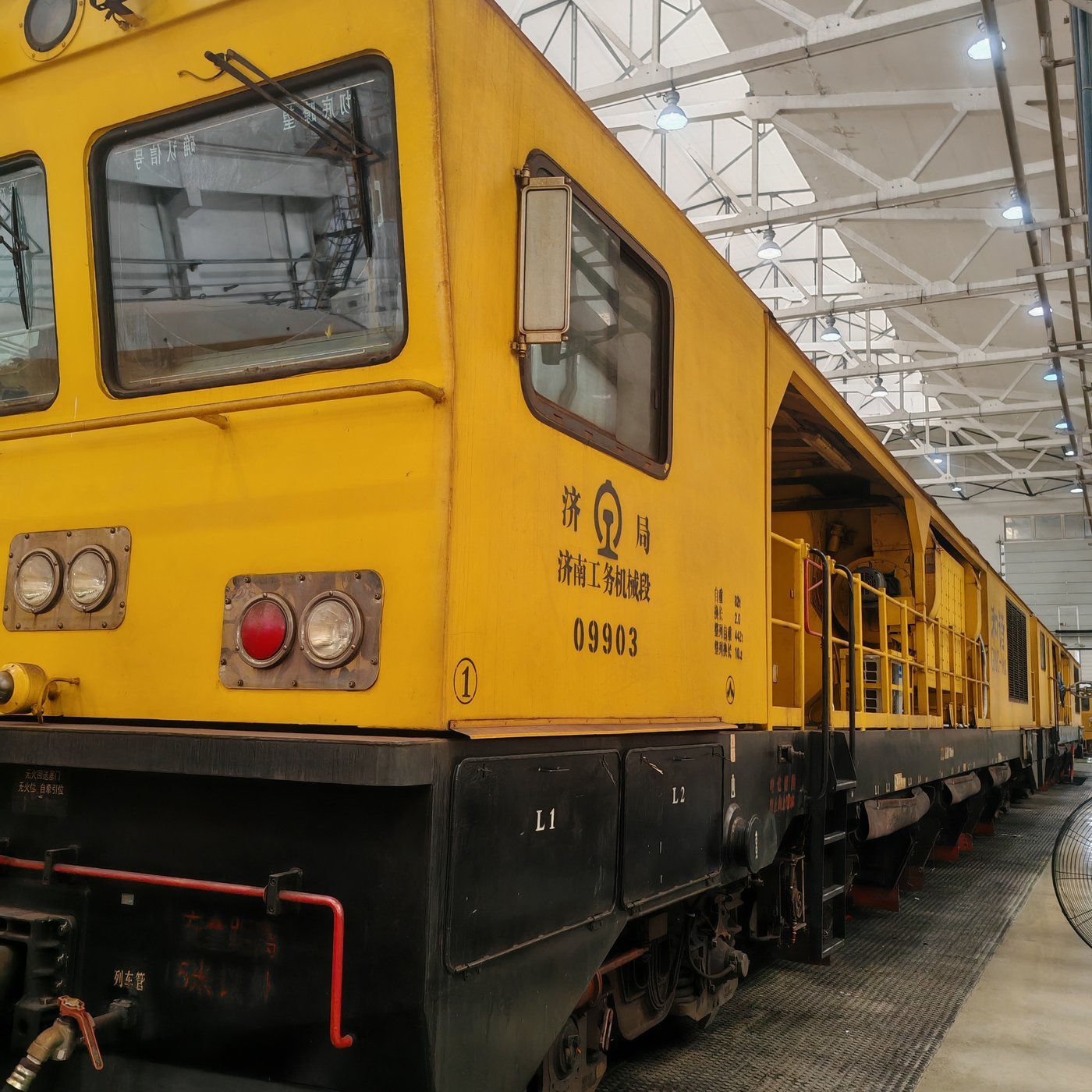
On the Shenhua Shuohuang heavy-haul line, 48 wheels were fitted to one half-car and run at 13.8 kW and 15 km/h over 172.8 pass-kilometres: average wear thickness 34.67 mm, that is 4.98 pass-km per mm, an average life of 199 pass-km, with no abnormal vibration, no iron chips bonded to the wheel face and no continuous blueing. Over 800 wheels of this design have now been fitted to GMC-96B grinding trains, and the unbalance measured on the third-party report for this class is 15 g against a 21 g requirement. If your train vibrates, the wheel records are the first thing to rule out — see rail grinding wheels built to these limits and our note on restoring profile to eliminate abnormal vibration.
Related questions you may also ask
How to prevent rail grinding wheel cracking during operation? Why is my rail grinding wheel glazing and not cutting? Can one rail grinding wheel fit different grinding machines? Rail burning prevention: why the wheel choice matters most More answers on rail grinder wheelsBalance records with every wheel
Tell Molaton your machine, your head layout and the vibration you are seeing. We will match the wheel to the head and supply the balance, run-out and burst-test documentation that goes with each batch.
Ask for Wheel Balance Data