Resin bond vs vitrified bond rail grinding wheels: what is the difference?
- Share
- Issue Time
- Sep 26,2026
Resin bond vs vitrified bond rail grinding wheels: what is the difference?
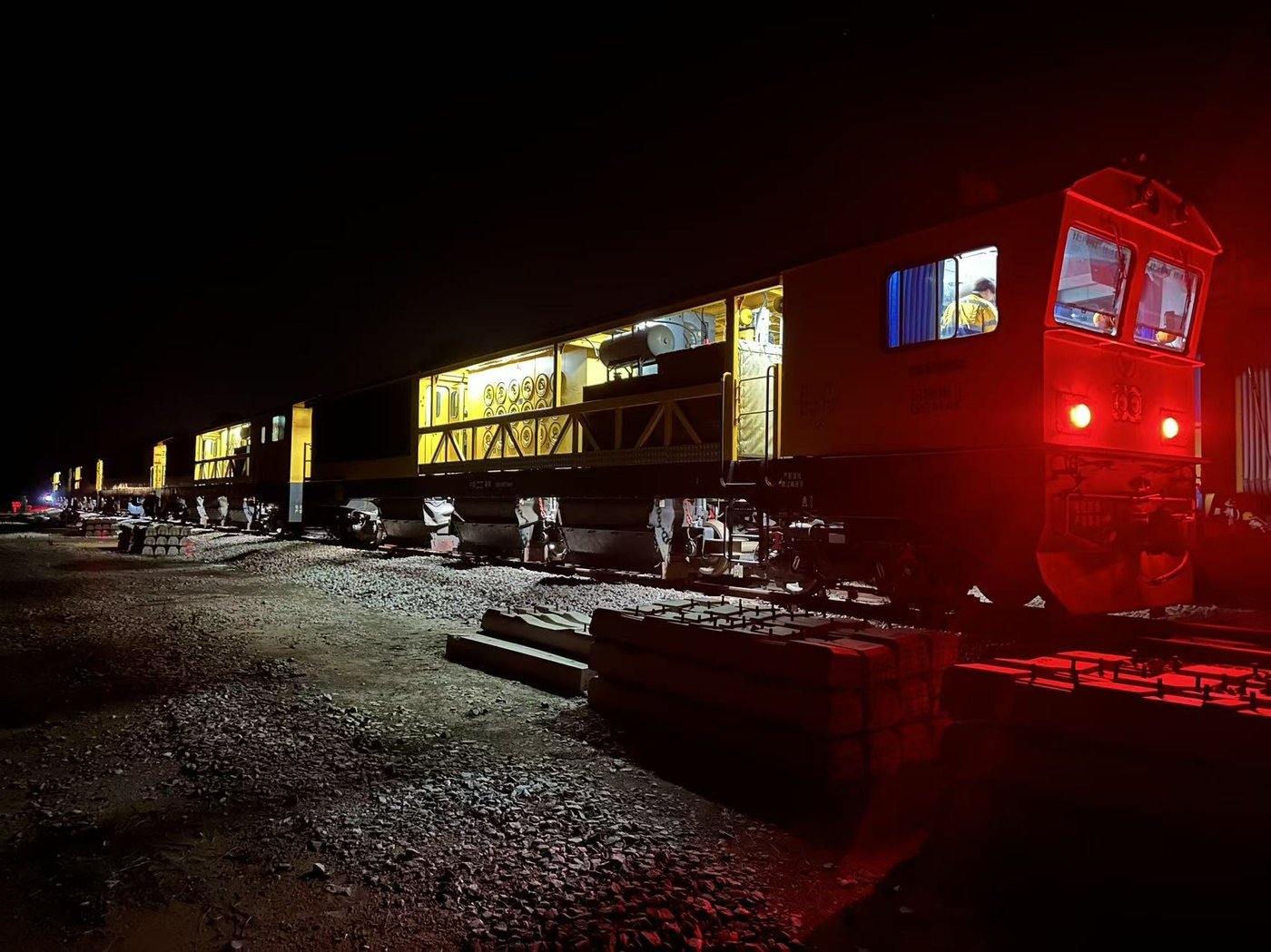
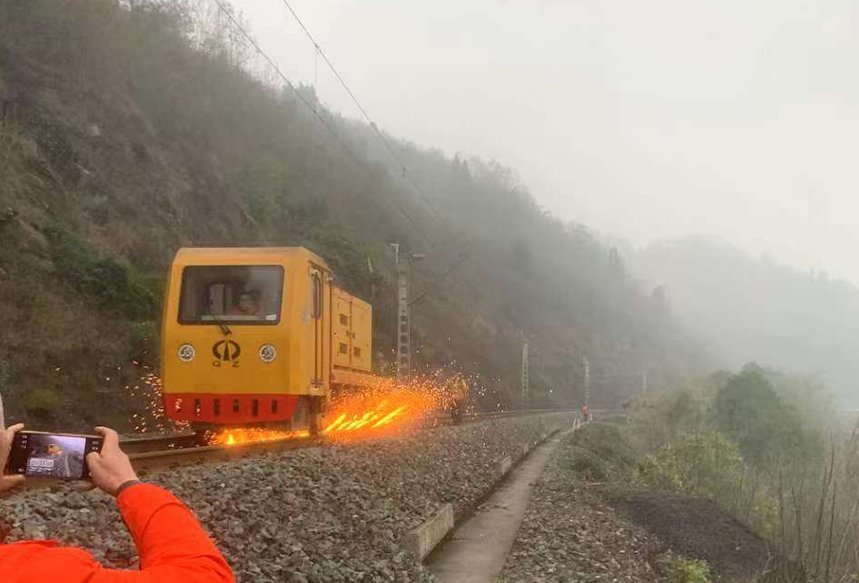
Rail grinding wheels are resin bonded. Vitrified (ceramic) bonded wheels are not used on rail grinding trains, and there is a mechanical reason for it. A resin bond is elastic: it holds the grain firmly enough to cut, yet flexes and yields when a wheel meets a dipped weld, a frog point or an irregular joint at 50 m/s, and it is tough enough to take a glass-fibre wrap. A vitrified bond is hard, rigid and chemically stable, but it is brittle with poor thermal conductivity — exactly the wrong combination for rail grinding's high speed, high load, high temperature and heavy vibration. Every active and passive high-speed rail grinding wheel on trains today, in every fleet we supply, is a resin-bonded wheel.
The three bond families, and where each one stands on rail
| Bond | Character | Behaviour under rail grinding conditions | Used on rail grinding trains? |
|---|---|---|---|
| Resin (phenolic) | High strength and toughness, low raw-material cost, simple forming, tolerant of shock and thermal cycling | Flexes instead of fracturing at 50 m/s; can be glass-fibre reinforced; renews grain by bond wear, which is the self-sharpening action rail grinding needs | Yes — the standard bond for active and high-speed passive rail grinding wheels, worldwide |
| Vitrified (ceramic) | Chemically stable, heat resistant, dimensionally rigid, but brittle with poor thermal conductivity | Cannot absorb the impact of an irregular rail contact or the vibration of a multi-head train; heat builds at the contact zone instead of dissipating | No — no ceramic-bonded rail grinding wheel is reported in line service |
| Metal | Highest strength, heat conduction and wear resistance; sintered, more complex and costly to make | Iron-bond wheels measured a grinding ratio of 686, about 15× a resin wheel — but the bond is so strong it does not wear back, so the grain never re-exposes and the wheel glazes | No — it also needs dressing, which a grinding train cannot do, so there is no line-grinding case for it |
The metal-bond result is instructive rather than a contradiction: wear resistance alone does not win on rail. A rail wheel has to balance grain hold and grain release. A bond that holds too well stops cutting; a bond that releases too easily consumes the wheel and the budget.
Inside the resin bond: what actually changes on-track performance
The resin is not one material. Rail wheels use heat-resistant phenolic resin, and commonly its modified grades — epoxy, polyvinyl chloride, polyamide, polyvinyl formal and bismaleimide-modified phenolics — with polyaromatic-ether and polyimide resins used where heat and mechanical performance must be higher still. In our own development programme we screened a high-temperature resin (PR-55738) specifically to raise thermal stability, and settled on the best-performing resin grade after comparative testing.
Bond content is tuned, not maximised. Three wheels were made at low, medium and high bond content: their compressive strengths measured 68.9 MPa, 95.2 MPa and 122.7 MPa. The strongest wheel cut worst — a bond-rich structure is so dense that the grain cannot protrude, so grinding ability falls. The weakest wheel did not reach the strength of the wheel it was replacing. Medium bond content gave the best combination of removal rate, grinding ratio, roughness and rail surface quality.
Fillers do the fine tuning: copper powder, white alumina powder, silicon carbide powder, graphite, carbon black, molybdenum disulphide, chromic oxide, iron oxide, zinc oxide, cryolite and barytes. They must disperse and wet out in the resin, carry minimal moisture and volatiles, and be non-toxic and economical. Underneath all of it sits the interface: grain/bond de-bonding is the main reason corundum grains shed early, which is why resin wetting behaviour and interface bonding dominate wheel performance. Structurally, the wheel is hot pressed, the fibre is wound on, and the body is cured in a second stage — that glass-fibre wrap is what allows the 1.5× safety factor at 50 m/s.
Evidence: what a resin-bonded rail wheel is made of, measured
A sample of our wheel for a Loram-type vehicle was submitted to the National Abrasives & Grinding Tools Quality Inspection and Testing Centre (Zhengzhou Research Institute for Abrasives & Grinding, report No. F2022-08-1856). The composition analysis returned zirconia alumina 67.75%, brown alumina 1.20%, pyrite (FeS2) 9.77%, cryolite (Na3AlF6) 6.27%, CaO 2.28%, K2O 0.39% and phenolic resin 11.92%. So the bond accounts for roughly one eighth of the wheel mass, and the rest is grain plus functional fillers — a useful reality check when a supplier describes a wheel only by its bond name. The same report measured open porosity of 2.93% and bulk density of 3.17 g/cm³ to JB/T 7999-2013.
Bond behaviour is also visible in heat. On the rig at 3,600 rpm, our wheel face reached 124 °C maximum and 55 °C minimum, against 143 °C and 68 °C for the imported wheel: the bond and filler system pulls heat out of the contact zone, and that is what prevents blueing. When early samples did show line burning, the fix was a formulation change — adjusting density and hardness, raising the composite grain share and widening the aerogel pore range to improve heat conduction.
Finally, the acceptance rules that bind a resin wheel are the same ones our production is checked against: GB 2494 for bonded abrasive safety at 50 m/s, GB/T 2492 for balance at G1 (limit 30 g) or G3 (34 g), JB/T 7992 and JB/T 11431 — the rail grinding wheel standard RailwayCare drafted — for dimensional tolerances, and Q/CR 1-2014 for railway-specific wheel acceptance. Molaton rail grinding wheels are produced against those limits, with each batch traceable to its test data.
Related questions you may also ask
What is the difference between a rail grinding wheel and a grinding stone? What grit size and abrasive should I use for rail grinding? What types of railway grinding wheels are available for different railways? Rail burning prevention: why the wheel choice matters most What actually drives the cost of a rail grinding wheelBond, grain and grit — specified for your duty
Send the machine model, the rail type and the defect you are chasing. Molaton will specify the bond system, grain blend and grit, and back it with composition and test data for the batch you receive.
Ask for a Wheel Specification