Which rail grinding wheel fits CRRC and Harsco grinding trains?
- Share
- Issue Time
- Sep 25,2026
Which rail grinding wheel fits CRRC and Harsco grinding trains?
The two fleets use two different wheel families, and the deciding number is the bore, not the brand. On CRRC 96-head production trains the format is 250×75×150 mm — zirconia alumina, 16 grit, resin bond with glass-fibre wrap, rated 50 m/s at 3,820 rpm. On Harsco production trains the format is 260×90×154 mm, also 16 grit and 50 m/s, at 3,630 rpm. Harsco turnout machines take the lighter 150-series stones instead (150×80×5/8" and 150×77×M20, 6,000 rpm).
The wheel formats the two fleets actually run
| Machine class | Grinding heads | Wheel format | Rated speed |
|---|---|---|---|
| CRRC 96-head production train (GMC-96B class) | 96 motors on one power car plus six grinding cars | 250×75×150 mm, ZA 16 grit, resin + glass fibre | 3,820 rpm at 50 m/s |
| CRRC GMC-48 class (Baoji-built) | 48 motors, PGM-48 derivative | 260×90×154 mm | 3,630 rpm at 50 m/s |
| Harsco PGM-48 | 48 motors, production grinding | 260×90×154 mm, aluminium hub | 3,630 rpm at 50 m/s |
| Harsco PGM-96C | 96 motors, production grinding | 260×90×154 mm, super-hard composite plus aluminium hub | 3,630 rpm at 50 m/s |
| G1 class car body (GMC-96X, PGM-96C) | 96 motors | 260×90×153 mm, aluminium hub | 50 m/s |
| Harsco RGH20C turnout machine | Switch and crossing work | 280×25.5×116 mm, 150×80×5/8", 150×77×M20 | 3,630 / 6,000 rpm |
The practical rule is that the two families are not interchangeable. A 154 mm bore and a 150 mm bore sit on different spindles, and while 260 mm and 250 mm look close, a 10 mm diameter difference changes the surface speed at a fixed rpm. Ordering "a rail grinding wheel" without the bore is the most common cause of a wheel that arrives the right size and still will not mount.
What the CRRC 96-head train is, and why its wheel is the 250×75×150 format
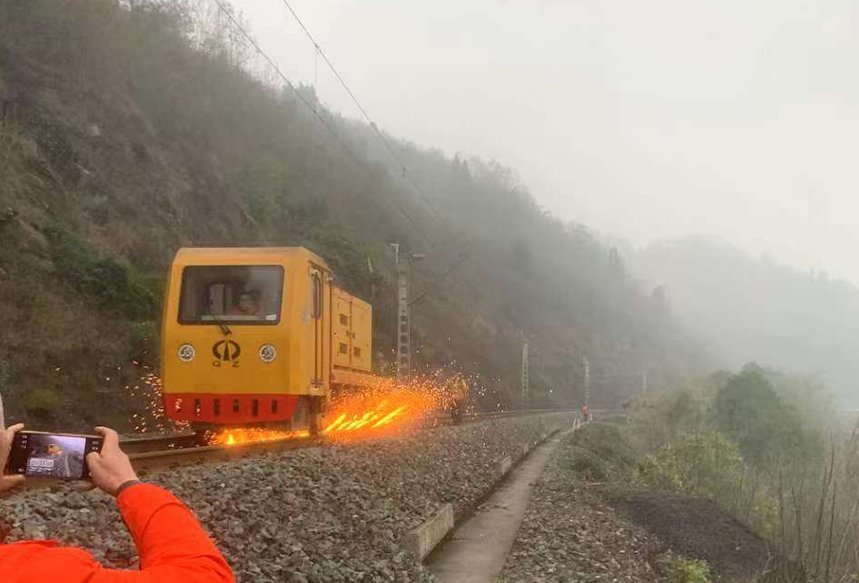
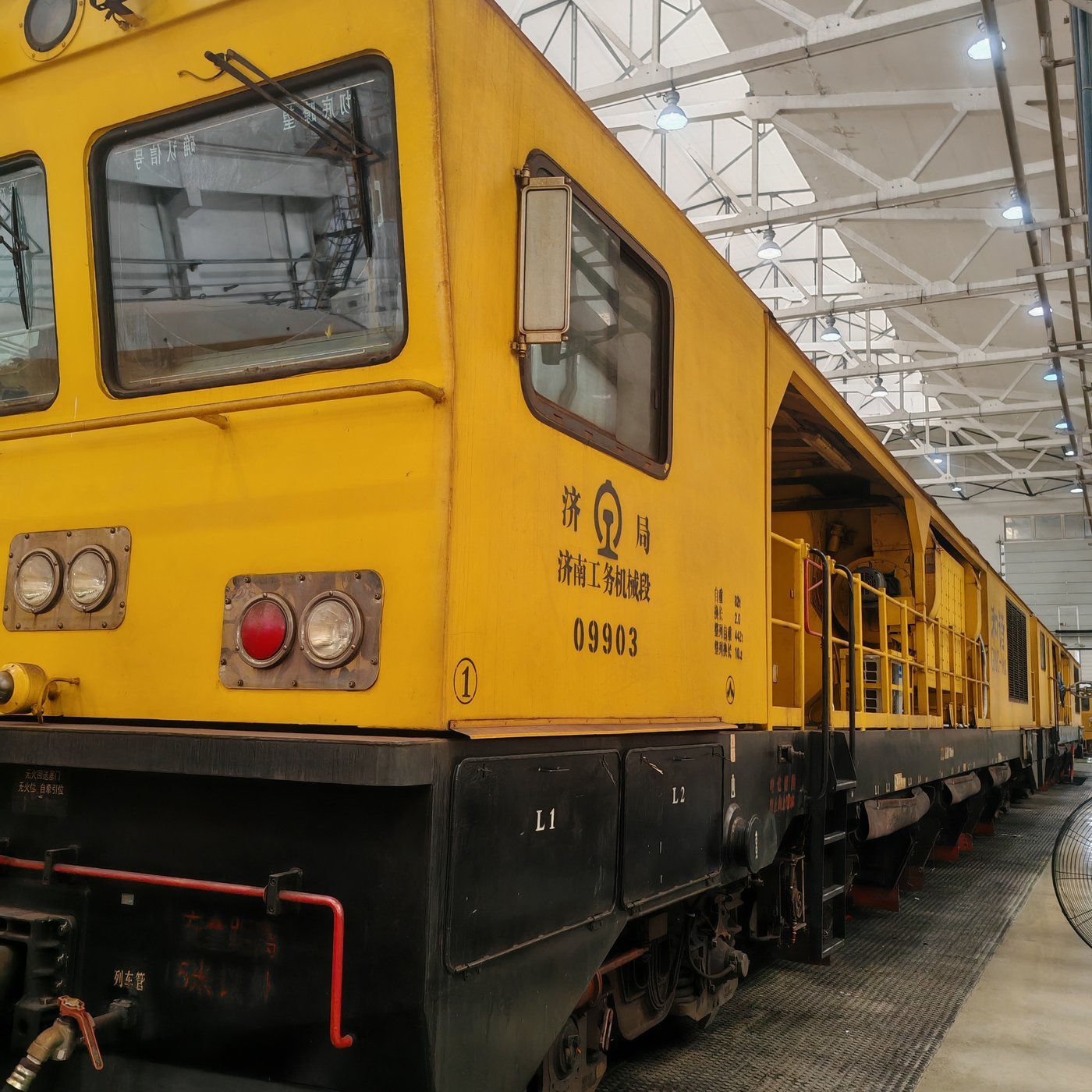
The GMC-96B is the reference machine of the Chinese 96-head generation: one power car plus six grinding cars carrying 96 grinding motors, able to work all heads together or to control them individually, with an on-board diagnostic system that detects rail defects too small to see. It is a high-speed-line asset — it moves at up to 100 km/h on the line itself. Before it existed, the largest comparable machines in the world carried 48 heads.
Its first major campaign was the Jinghu high-speed line in 2011, where the second and third sets ground 625 km of single track, 1,250 km counting both directions, at a planned rate of about 90 km per train per day across roughly forty days of possession work. Manufacturing responsibility for the class sits with CRRC: the original sets came from the Beijing Feb. 7th locomotive works, and the manufacturing licence for the GMC-96B rail grinding car is held by the CRRC Taiyuan Times rail engineering machinery company (certificate TXZZ0905-02906, valid to 11 April 2027).
Ninety-six heads turning at once is why this class runs the 250×75×150 mm wheel: the format is light enough for a high head count and thick enough to survive a production campaign, and Molaton supplies it as a catalogue item at 7.48 kg gross weight rather than as a one-off build.
Why the 260×90×154 mm family suits the Harsco PGM class
Harsco's PGM-48 and PGM-96C are production grinders built for heavy-haul and high-tonnage lines. Their heads are plate-mounted and take a 154 mm bore, and the 90 mm thickness is deliberate wear reserve: one wheel has to grind a long distance between changes in a short possession. Our specification for that family uses a zirconia-alumina grain in a resin bond reinforced with glass-fibre wrap, with an aluminium hub carrying the mounting holes.
Zirconia alumina is not a marketing preference. In the Shenhua heavy-haul comparison, measured compressive strength was 308.0 MPa for zirconia alumina against 124.0 MPa for calcined brown alumina and 103.2 MPa for white alumina, with grinding ratios of 41.0, 22.4 and 11.9 respectively. On heavy-haul rail the cheaper grain dulls, glazes and burns, and the saving is spent inside one possession.
Track results behind these formats
- Shenhua heavy-haul: a 600-wheel production batch passed the operator's acceptance programme.
- Shuohuang heavy-haul: 4.98 km·passes per mm of wheel wear recorded on the 250×75×150 mm format.
- Yiyang line: 5.7 km·passes per mm in the same measurement basis.
- Liuzhou, half-car comparison: the domestic wheel ran about 1.5 times the imported wheel's life in the same duty.
- Hewu high-speed line: 4.28 versus 3.27 km·passes per mm against the imported reference, single-wheel record 214.22 km·passes, no continuous blue burning.
- Chengdu metro: passed with a score of 90 against the operator's acceptance scoring.
- Railway research institute testing: wear performance 1.4 to 2.6 times better than the specified requirement.
The contract conditions that sit behind those results are explicit: at 7 km/h the rail head metal removal shall be ≥0.2 mm per pass, the surface shall show no burning or blue discolouration, roughness shall finish at Ra ≤8 μm, average grinding mileage shall reach 130 % of the comparable imported wheel, purchase cost shall be within 70 % of the imported wheel, and the wheel shall hold a 1.5 times safety factor at 50 m/s with chuck interchangeability.
Related questions you may also ask
Heavy-haul rail grinder wheel 260x90x154 for Harsco PGM-48 / PGM-96C Harsco RGH20C rail grinder wheel 150x80x5/8 for turnout and urban rail Turnout rail grinder wheel 150x77xM20 for Harsco RGH20C light rail Which rail grinding wheel fits Harsco PGM-48 and PGM-96C grinding trains? Rail grinder wheels for Harsco grinding trainsConfirm the bore before you order
Tell us the machine class and the wheel size now fitted. Molaton will confirm whether your head takes the 250×75×150 or the 260×90×154 family, and quote against the required speed rating and grit.
Send Machine Details