How do I choose a rail grinding company?
- Share
- Issue Time
- Sep 23,2026
How do I choose a rail grinding company?
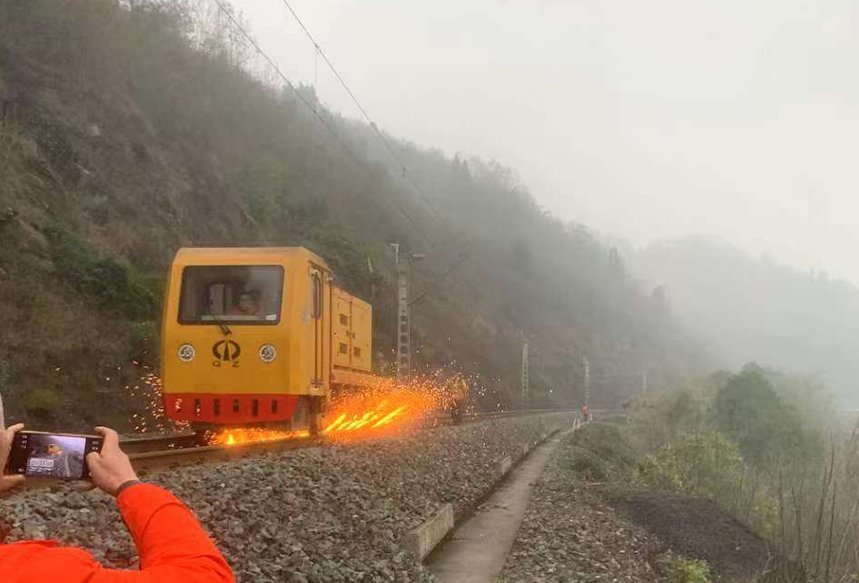
Choose on four measured things, and ignore the fleet photographs. One: the metal removal per pass the contractor achieves at the speed they will actually run on your track. Two: the acceptance data they hand over at the end of the possession, not a verbal assurance that it looks good. Three: the cost of the grinding stones behind the contract, because that is where the real money moves. Four: how much of your possession window they actually use. A grinding contractor's output is bounded by machine time and consumable life — so a supplier whose stones last longer, or who can keep the machine cutting between two trains, delivers more of your window than one with a lower day rate.
1. Write the acceptance clause first, then ask who can meet it
Most bad grinding contracts are written loosely and settled by argument. Put the numbers in the tender and the shortlist becomes obvious. These are the criteria the industry actually measures against:
| Criterion | Value to write into the contract |
|---|---|
| Surface roughness | Ra ≤ 10 μm measured on the rail head |
| Surface condition | No continuous blue-banding; no periodic wheel marks; no burning |
| Flatness | ≤ 0.3 mm under a 1 m straightedge with feeler gauge |
| Ramp | Steeper than 1‰ at the ends of the ground zone |
| Removal depth | ≤ 0.5 mm total; preventive work ≥0.1 mm and corrective work ≥0.2 mm at the head centre |
| Profile fit | GQI ≥ 85 for excellent (standard deviation ≤8) and ≥70 for acceptable (SD ≤10) |
| Profile zone tolerance | Head centre +0.2 / −0.4 mm; zones 2–4 ±0.2 mm from design profile |
| Contact band | 25–30 mm on high-speed turnouts; 35–40 mm on conventional and heavy-haul track |
Profile fit is the criterion that separates suppliers, because it cannot be faked by a slow, careful operator. It measures how closely the transverse shape you finish with matches the design profile — and it is produced by the stone and the machine's copying system together. Ask each bidder to supply the last three GQI reports they issued, not the percentage of work they describe as satisfactory.
2. Meter the removal instead of accepting a description
Take a transverse profile of the rail at fixed points before the machine arrives, and again at the same points after it leaves. That single discipline turns a vague tender into arithmetic. On a Loram DM01 grinding car trial run in 2026 at 80% power and 7 km/h on straight track, the measured metal removal from profile comparison was:
| Measuring zone | Metal removed per pass |
|---|---|
| Inner rail region +20° to +5° | 0.142 – 0.241 mm |
| Outer rail region −20° to −2° | 0.165 – 0.326 mm |
| Rail head +5° to −2° | 0.193 – 0.222 mm |
| Stone consumption | 0.079 – 0.151 mm of stone per 100 m per pass |
Two things follow. First, you can now price a grinding programme per pass-kilometre instead of per shift, which is the only basis on which bids are genuinely comparable. Second, you can see when a bidder is buying tonnage with speed: a machine running faster than the removal rate supports will need more passes, and more passes cost window, not just money.
3. Plan the cycle so the tender has a real job size
Before you ask for prices, decide how much grinding the network needs. Preventive grinding on a schedule removes less metal per visit and is cheaper over the life of the rail than corrective grinding after defects have appeared. Chinese practice sets the cycle by traffic and curve radius; UK practice sets it by tonnes since last pass:
| Track type | Grinding interval |
|---|---|
| High-speed line (China) | Every 30–50 Mt of traffic, and at most 2 years apart |
| Conventional line, straight and large radius (>1200 m) | Every 100 Mt |
| Conventional line, small radius (<1200 m) | Every 30–50 Mt |
| UK curves (Network Rail practice) | Roughly once per 15 Mt |
| UK straight line (Network Rail practice) | Roughly once per 45 Mt |
Get the interval roughly right and you can tender a multi-year programme, which is what makes a contractor invest in mobilisation for your railway. Get it wrong in the corrective direction and you will be buying emergency possessions, where the removal rates above matter much less than whether anyone can attend at all.
4. Follow the money: the stone line is the cost line
The largest controllable cost in a grinding contract is the consumable, so ask four questions of every bidder. Who supplies the stones, and are they pressed for this machine class or bought on the open market? Is stone consumption charged per pass-kilometre or per piece? What is the average pass-kilometre life they guarantee? And what happens to the rate if the stones last twice as long as assumed?
The economics are not theoretical. When Network Rail invested about £36m in three grinding trains designed and built by Loram and operated by Colas Rail, the stated gains were roughly £1,000 saved per shift and about 35% more output than the fleet they replaced, on a design life of 30 years. Those savings came from fewer shifts doing more metal, not from a cheaper day rate. The same logic applies to consumables — and it pays to test the claim rather than accept it. In our own 2026 comparison on a Loram DM01 grinding car, three stone suppliers including Molaton were found to be close in combined performance, with prices running about RMB 740 to 1,390 per stone; the honest conclusion is that price and supply stability decide that particular line, not brand. That is the standard of evidence you should demand from whoever supplies your grinding stones: measured, comparable, and willing to state where it is not ahead.
Related questions you may also ask
Who are the leading rail grinding machine manufacturers? What factors determine the rail grinding cycle? Loram grinding train vs Molaton rail grinding vehicle?Price the wheel line behind your grinding programme
Whether you tender the work out or grind in house, the consumable is the line you control. Send us the machine class, the removal per pass your contract demands, your working speed and your possession length — and we will set out a Molaton wheel specification with a guaranteed pass-kilometre life, so the comparison against your current supplier is arithmetic.
Get a Grinding Wheel QuoteOur approach to grinding programmes is set out under the rail grinding solution and the rail grinding products and service overview, with delivered work at switch and crossing maintenance in a freight marshalling yard and a high-performance grinding solution for a railway bureau. For the buying side of the same decision, read rail grinding services, contracts and acceptance, how to evaluate and select grinding companies, what operators pay per kilometre and what actually drives the cost of a grinding wheel.