What is the Geismar MC3 rail grinder?
- Share
- Issue Time
- Sep 23,2026
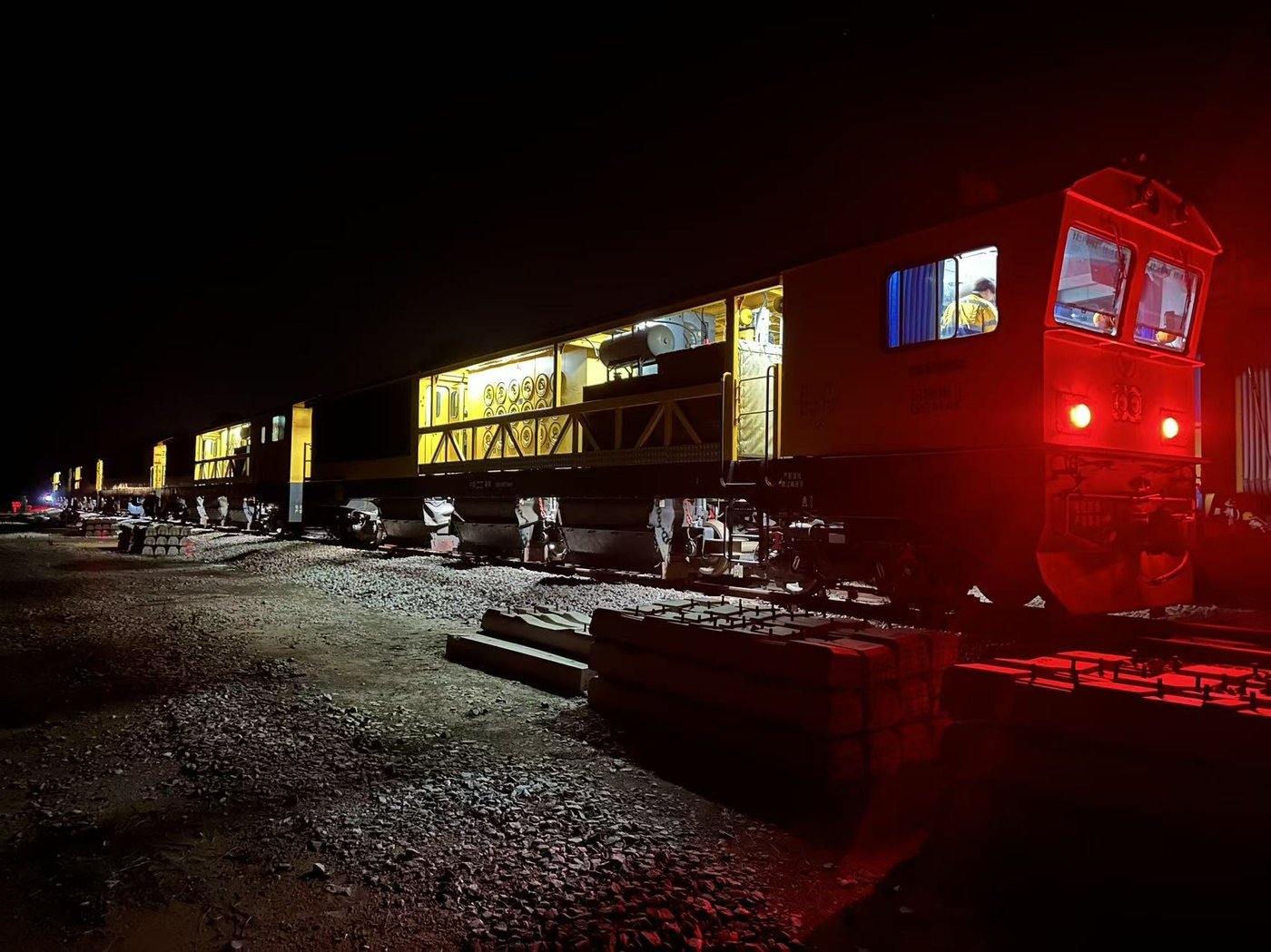
What is the Geismar MC3 rail grinder?
The Geismar MC3 — catalogued as the Metal Hornet MC3 — is a walk-behind frog point and check rail grinding machine built by Geismar, the French track equipment manufacturer founded in 1924 in Colmar and today headquartered at Colombes as Geismar Rail Industry Technologies & Services. It is a specialist tool, not a production grinder: it is the machine that goes where a grinding train cannot, working through switches and crossings and either side of the rail head, with narrow stones for the confined zones around check rail and grooved rail. Its envelope is fixed by four numbers — stones of 230–260 mm, up to 385 mm horizontal and 185 mm vertical stone stroke, and a 50 m/s peripheral speed class.
What the MC3 grinds, and what sets its limits
A Geismar MC3 is designed around reach rather than removal rate. Geismar's own description is precise about the duty: grinding operations through switches and crossings and either side of the rail head, with the “narrow type” stone letting the operator work in the most confined areas around check rail and grooved rail. Two design choices support that duty — all mechanical parts are made from special steel to lengthen machine life and cut maintenance cost, and the frame leaves the grinding area visually open so the operator can see the contact point and stop at the right depth instead of guessing.
Engines are petrol, diesel or electric depending on build. The petrol versions run a 4-stroke industrial engine of roughly 3.6–6 kW at 3600 rpm (Honda GX160/GX200/GX270 or Briggs & Stratton class), and that engine speed is what the stone has to survive.
| Parameter | Geismar MC3 as documented |
|---|---|
| Machine type | Walk-behind frog point and check rail grinder, Metal Hornet range |
| Engine | Petrol, diesel or electric; petrol builds about 3.6–6 kW at 3600 rpm, pull-rope start |
| Stone inclination | Up to 25° to the track axis, ±30° from the vertical axis |
| Stone stroke | Horizontal up to 385 mm; vertical up to 185 mm |
| Stone diameters accepted | 230 / 250 / 254 / 260 mm depending on build |
| Maximum peripheral speed | 50 m/s (some builds 80 m/s) |
| Arbor preset speed | 3600 rpm for stones up to 254 mm; 3300 rpm for 260 mm |
| Resulting stone rotation | About 3570 rpm (≤254 mm) or 3270 rpm (260 mm) |
| Dimensions | 2160 × 1100 × 1030 mm |
| Mass | Approx. 95–135 kg (99–115 kg depending on engine) |
| Noise / vibration | 78–86 dB(A); 1.1–3.2 m/s² at the operating lever |
Two of those rows decide whether a wheel is legal on the machine. The arbor is preset to 3600 rpm for stones up to 254 mm and 3300 rpm for 260 mm stones, which becomes a stone rotation near 3570 rpm and 3270 rpm. Those are machine speeds — the stone's own rating must sit above them, not equal them.
The consumable: which stone an MC3 takes
The MC3 operating manual states three compatibility conditions, and they apply to every hand-guided rail grinder worth buying a stone for. The stone's maximum operating speed must be higher than the maximum arbor speed marked on the machine. Its outside diameter must not exceed the maximum diameter marked on the machine, which can be 230, 250, 254 or 260 mm depending on build. And it must be a resinoid wheel authorised for this class of machine. The manual then lists specific wheels separately for flat-bottomed rail and for grooved rail — because the confined zones that make the MC3 useful also change the stone geometry.
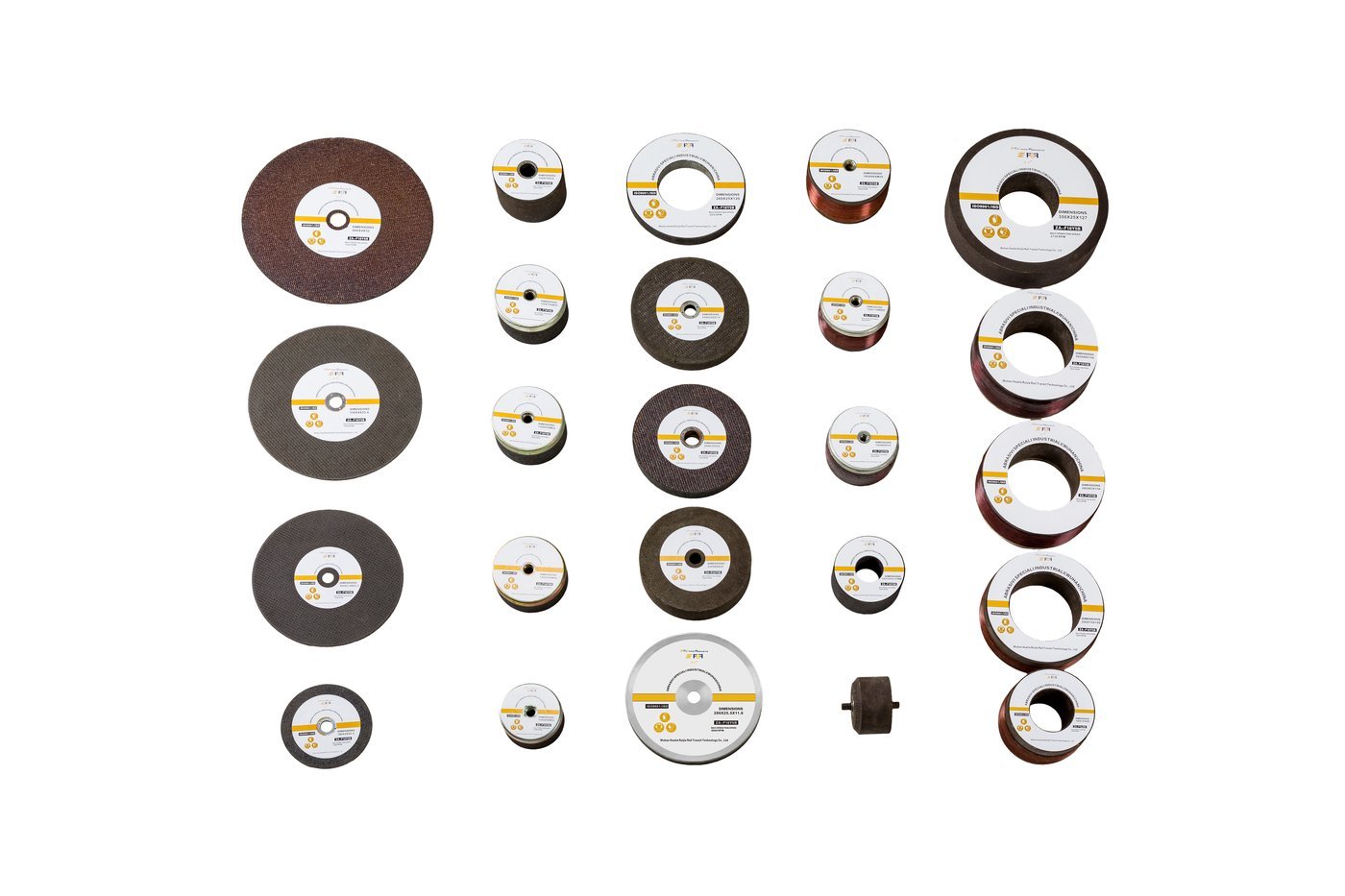
Molaton has manufactured rail grinding wheels since 2004 and supplies the Geismar / Robel portable family against exactly that list. The current range reads:
| Stone as catalogued (OD × thickness × mounting) | Construction | Grit | Max speed | Rated stone speed |
|---|---|---|---|---|
| 260 × 25 × 120 mm | Zirconia alumina / brown fused alumina, AZ/A F20J9B | 20 | 50 m/s | 3600 rpm |
| 254 × 32 × 25.4 mm | Iron matrix with zirconia / brown fused alumina | 20 | 50 m/s | 6000 rpm |
| 250 × 32 × 32 mm | Zirconia alumina / brown fused alumina, AZ/A F20J9B | 20 | 50 m/s | 6000 rpm |
| 180 × 80 × M20 mm | Iron matrix with zirconia / brown fused alumina | 20 | 50 m/s | 5000 rpm |
| 150 × 75 × 32 mm | Iron matrix with zirconia / brown fused alumina | 20 | 50 m/s | 6000 rpm |
| 150 × 70 × M20 mm | Zirconia alumina / brown fused alumina, AZ/A F20J9B | 20 | 50 m/s | 6000 rpm |
| 125 × 65 × 20 mm, 54 × 47 boss | Iron matrix with zirconia / brown fused alumina | 20 | 50 m/s | 7500 rpm |
The 250, 254 and 260 mm stones are the ones that sit on an MC3-class machine; the 125 and 150 mm sizes belong to the handheld Geismar and Robel grinders, where the same 20-grit zirconia specification is used. All of them are rated to 50 m/s, which clears the MC3's own ceiling, and the zirconia content is deliberate: zirconia alumina outperforms traditional brown corundum in cutting action on rail steel, which is why it is the default abrasive on this duty rather than a premium option.
Case and data — what switch grinding is worth, measured
Crossing and switch grinding is judged on ride quality and profile fit, and both are measurable rather than a matter of opinion. On Chinese high-speed turnouts, grinding the crossing and switch zone has been reported to take car-body lateral acceleration from about 0.20 m/s² down to about 0.04–0.08 m/s² — the difference between a kick and a smooth transition. The target is a contact band 25–30 mm wide on high-speed turnouts and 35–40 mm on conventional and heavy-haul track, with the ground profile contacting the nominal rolling-circle region of the wheel and staying off the non-working edge of the head.
The finish is then held to a written acceptance envelope, not to the operator's eye:
| Acceptance criterion | Value |
|---|---|
| Surface roughness | Ra ≤ 10 μm (contract-grade target ≤8 μm) |
| Surface condition | No continuous blue-banding; no periodic wheel marks |
| Flatness | ≤ 0.3 mm under a 1 m straightedge with feeler gauge |
| Ramp | Steeper than 1‰ |
| Removal depth | ≤ 0.5 mm |
| Profile fit (GQI) | ≥85 excellent (SD ≤8); ≥70 acceptable (SD ≤10) |
| Profile zone tolerance | Head centre +0.2 / −0.4 mm; zones 2–4 ±0.2 mm |
This is the reason the stone matters as much as the machine on an MC3. Lateral acceleration, contact band width and Ra are all produced by the contact between grinding medium and rail steel; a stone that cuts unevenly, or that is half a millimetre out of thickness, shows up as periodic marks and a failed profile fit long before it shows up as a broken tool.
Related questions you may also ask
How do I choose a railroad rail grinder for switch and turnout work? What is a Speno rail grinding machine? Portable rail grinder vs full-size grinding train — which do I need?Match a stone to your Geismar MC3
Send the machine build, the stone diameter or drawing you replace, the arbor speed shown on the machine and the rail type — flat-bottomed or grooved. We will confirm the Molaton equivalent at the right diameter, mounting and speed rating, and quote it with the boss and bore dimensions your operator actually fits.
Get an MC3 Stone QuoteThe Geismar-compatible wheel range is listed under Geismar grinder wheels, with the 254 mm standard size under the 254 × 32 wheel for Geismar and Robel portable equipment; the machines themselves are compared under railway grinders, and the wider workflow is set out in our turnout grinding solution and in rail profile grinding standards and best practice.