What does train maintenance involve?
- Share
- Issue Time
- Sep 16,2026
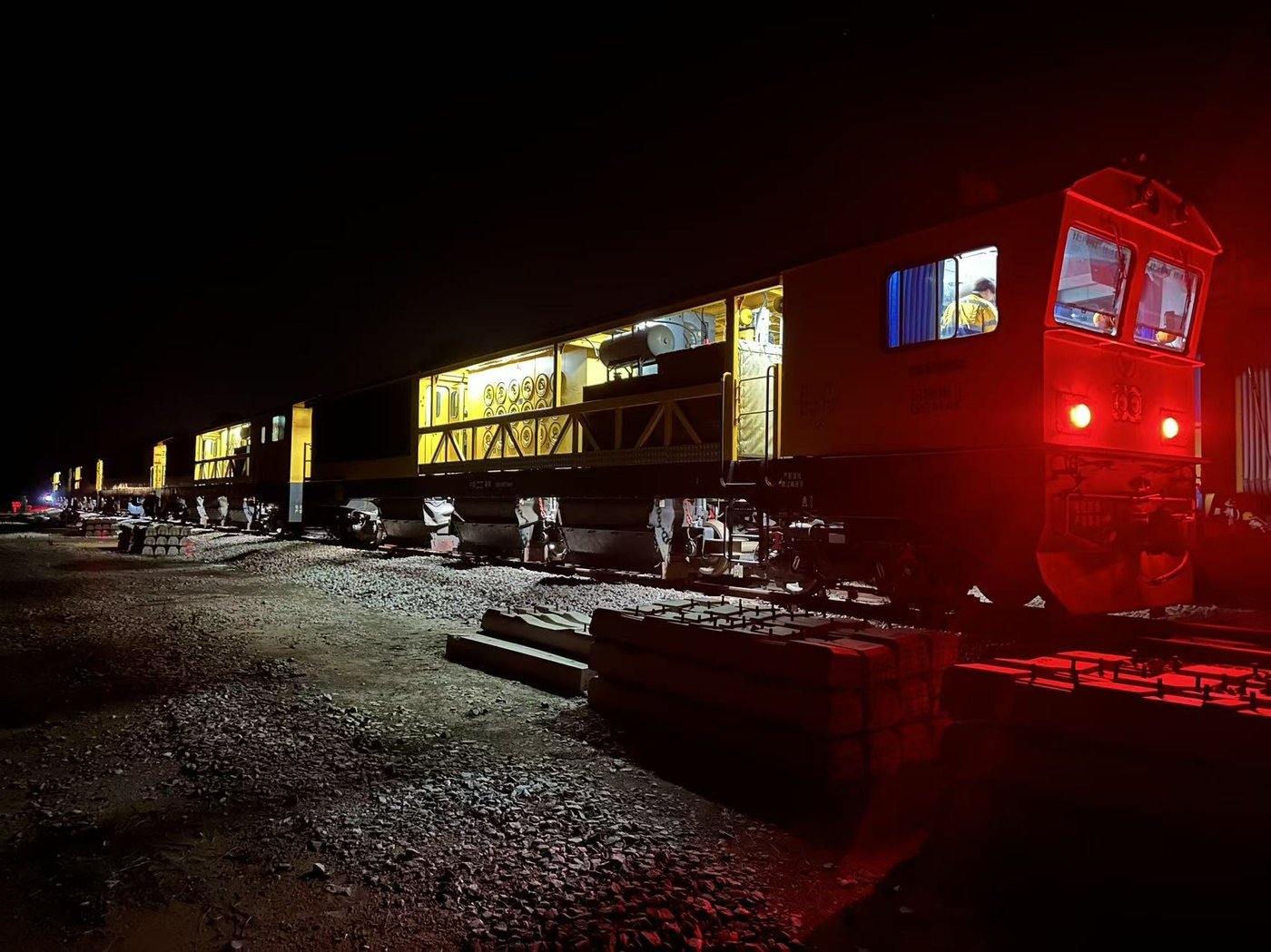
What does train maintenance involve?
Train maintenance is all the scheduled inspection, servicing and repair work done on the vehicle itself: running gear and wheelsets, braking, traction and electrical systems, doors, HVAC and passenger systems, and on-board safety and signalling equipment. It runs on a fixed plan — pre-service checks, periodic inspections at mileage or date intervals, and workshop overhauls. What operators routinely under-manage is the other half of the equation: a train is only as good as the rail it runs on, and rail condition drives a large share of the wheel and bogie wear that shows up in the workshop.
What train maintenance covers
| System | What the work involves |
|---|---|
| Pre-service and daily checks | Brake function, doors, warning devices, visible damage, consumable levels — a release-to-service decision, not a repair |
| Running gear and bogies | Frames, suspension and dampers, axleboxes and bearings, ride quality faults traced back to the bogie |
| Wheelsets | Tread and flange measurement against limits, wheel re-profiling on a wheel lathe when the profile is out, axle ultrasonic testing |
| Braking | Brake pads and blocks, discs, air system, anti-skid and parking brake, plus brake performance testing |
| Traction and electrical | Traction motors, converters, cabling, batteries, auxiliary supplies, current collection (pantograph or collector shoe) |
| Doors, HVAC and interiors | Door mechanisms and detection, air conditioning, lighting, seats, accessibility equipment, cleaning |
| Safety and signalling | On-board ATP or ATC equipment, event recorders, horn, headlights, fire detection and extinguishing |
| Body and structures | Corrosion inspection, body repairs, gangways and couplers, roof equipment |
Cadence is set by the operator's maintenance plan from mileage accumulation and calendar intervals, from light periodic inspections up to heavy overhauls, with an availability target running alongside the safety target.
Why rail condition belongs in the train maintenance conversation
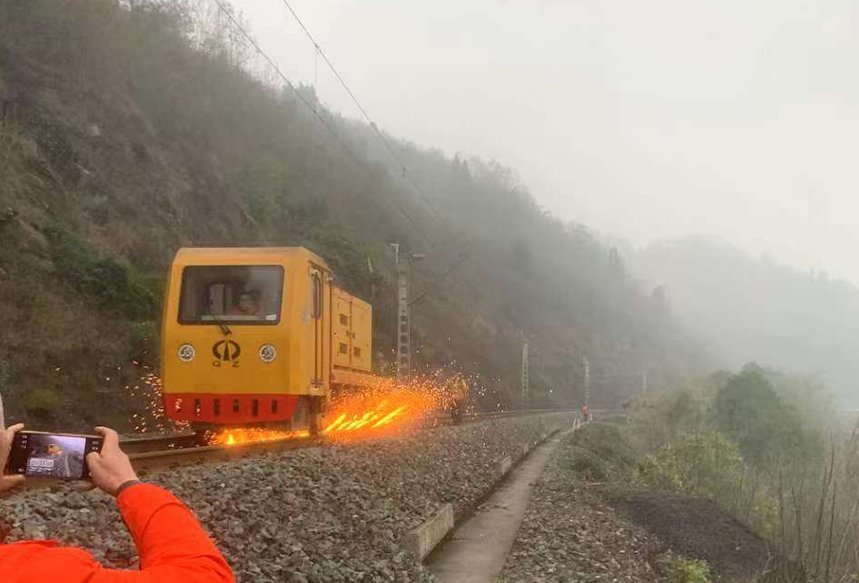
A vehicle only touches the infrastructure through the wheel/rail contact patch, and everything the rail does to that patch comes back as load into the train. RailwayCare engineering studies describe the mechanism directly: rail defects destroy the designed rail profile, degrade the wheel/rail contact condition, increase running noise and vibration, and accelerate the deterioration of vehicle components as well as the rail itself. Which defect dominates depends on the line — high-speed track suffers mainly rolling-contact-fatigue cracking, heavy-haul track crushing and lipping, and urban track with curves under 1,000 m radius side wear and corrugation, where the corrugation is the source of noise and vibration complaints.
Two numbers explain why the railhead has to be treated, not just inspected. Grinding at the wrong speed or depth leaves a hard, brittle white layer on the railhead measuring about 870 HV0.3 against roughly 340 HV0.3 for the parent metal — an increase of about 155% — which fractures early under wheel load and initiates cracks. And where the turnout profile has been restored properly, measured car-body lateral acceleration falls from about 0.20 m/s² to 0.04–0.08 m/s². That reduction in dynamic loading is felt by the suspension, the bogie and the wheelset, not just by the rail.
What good looks like on the track side
A grinding programme is judged on hard numbers rather than appearance: flatness within 0.3 mm under a 1 m straightedge, roughness Ra ≤ 10 μm, no blue burning, ramps better than 1‰ and no more than 0.5 mm of parent metal removed. The interval that protects both rail and rolling stock is set by cumulative tonnage: every 30–50 Mt on high-speed lines with no more than 2 years between passes, 100 Mt on straight and large-radius conventional track, and every 30–50 Mt on curves below 1,200 m radius. The full programme is described in the rail maintenance solution overview, and operator training for the machines and wheels is covered under RailwayCare grinding training.
Case and data
Since 2004 RailwayCare has made the wheels these programmes run on, and the fleet records behind them are the useful part for anyone writing a maintenance plan. A Molaton-wheeled GMC-96X on the Liuzhou network removed 18.72 pass-kilometres in a 2-hour possession window, with CYF wheels lasting about twice as long as the imports they replaced (20–30 mm against 43.5–59 mm consumed). On Hewu high-speed line the same comparison measured 4.28 versus 3.27 pass-kilometres per millimetre, best single wheel 214.22 pass-kilometres, and no continuous blue burning; the China Academy of Railway Sciences independently recorded wear 1.4–2.6× better than specification. On the Yiyang railway a wheel averaged 5.7 pass-kilometres per millimetre and on Shuohuang 4.98. Most recently, on the Loram DM01 trial at Jiangmen Huidafeng in 2026, Molaton stones ran without blue burning and held surface roughness at Ra 1.05–9.0 μm, mostly 2–4 μm. Third-party testing of the G1b 260×90×153 wheel at 50 m/s survived 4,775 rpm for 30 seconds, did not burst even at 6,354 rpm, and balanced to 21 g. Production capacity is now 500,000 wheels a year under ISO 9001, ISO 45001 and CRCC, to the standard JB/T 11431 RailwayCare drafted.
Related questions you may also ask
What is a rail grinder train and how does it work? What is rail maintenance and why does it matter? Railway grinder range for track and turnout workMatch the wheel to the duty, not to the catalogue
Tell us the machines in your fleet, your line type and your annual tonnage, and we will specify the wheel and the pass-kilometres you should expect from it. Existing part numbers can be matched like for like.
Specify My Wheels