What is the Network Rail grinder train?
- Share
- Issue Time
- Sep 14,2026
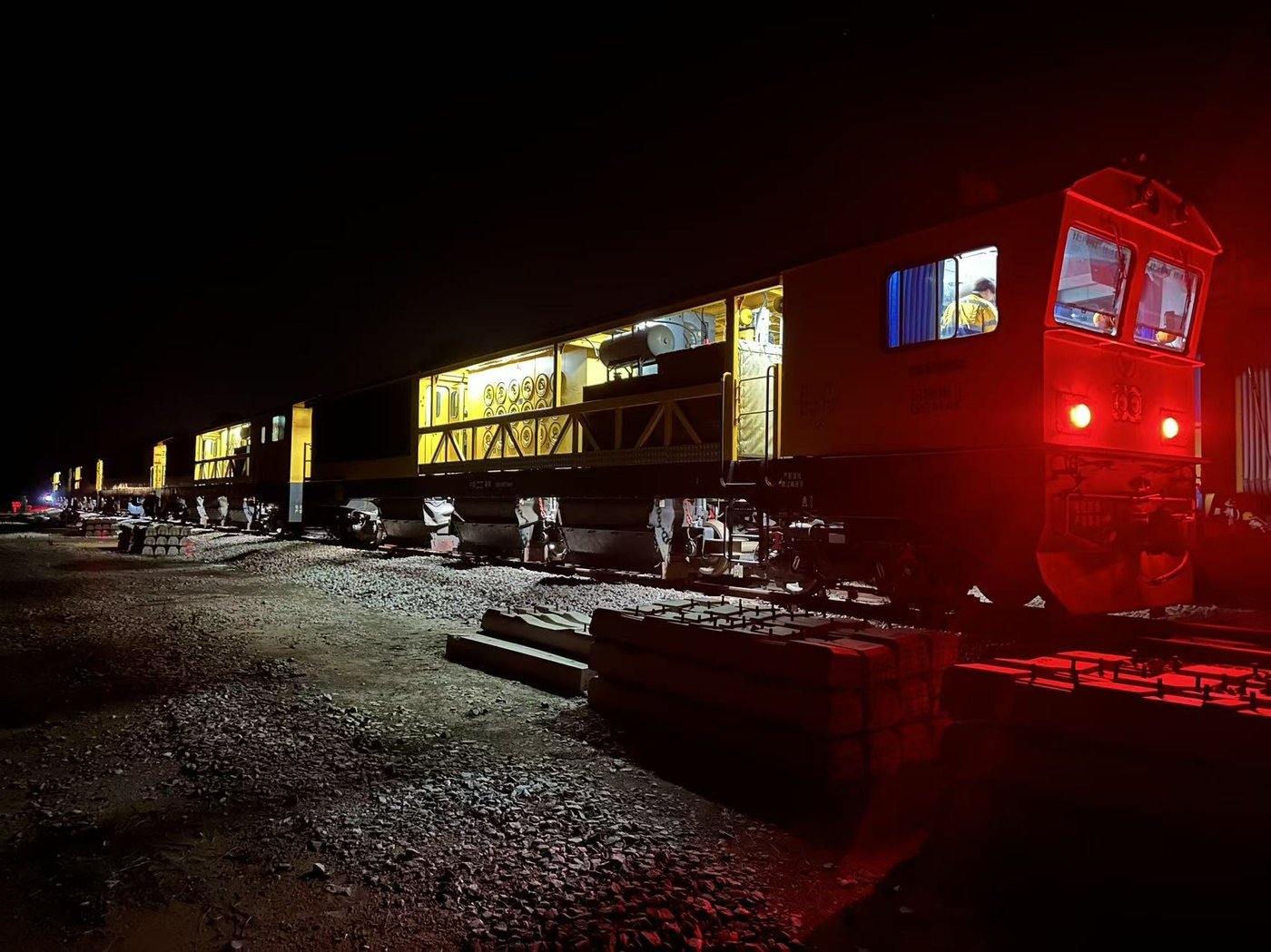
What is the Network Rail grinder train?
A Network Rail grinder train is a high-output rail grinding train that Network Rail — the infrastructure manager of the railway in Great Britain — runs over its network to cut a controlled layer of steel from the railhead. Its job is to remove rolling contact fatigue (RCF) and surface defects, and to restore the designed rail profile, so rails stay smooth, quiet and free of cracks that could grow into a break.
What Network Rail actually operates
Network Rail does not build grinding trains. It specifies and procures them, then contracts their operation to keep the network ground to profile. When the old fleet reached the end of its life, Network Rail invested £36 million in three new trains developed with Loram (design and build) and Colas Rail (operation and maintenance):
| Item | Detail |
|---|---|
| Fleet | Two four-car trains (C44-01, C44-02) plus one seven-car train (C44-03), each about 150 m long |
| Grinding stones | Four-car units carry 32 stones; the seven-car unit carries 64 stones across four grinding cars |
| Working speed | Grinding up to about 15 mph (25 km/h); metal removal up to 0.5 mm per pass |
| Transit speed | Up to 70–75 mph (110–120 km/h) so the train reaches work sites between services |
| Reported gains | About £1,000 lower cost per shift, roughly 35% more output, 30-year design life |
| Older fleet | Roughly five switch & crossing grinders, three cyclic preventive trains and three targeted-response trains |
The trains profile the rail by laser scanning and detect RCF cracks by eddy current, then calculate the optimum grinding pattern automatically — the same measure-then-grind logic used on any well-run grinding programme.
Why Britain grinds as hard as it does
After the Hatfield derailment in 2000, RCF became the defining rail-maintenance problem in Britain. Public industry figures put rail breaks on the national network at close to 1,000 per year around that period; well-established grinding cycles have since helped bring the typical figure down to roughly 100 per year, most now caused by the rail foot rather than the head. Preventive grinding is planned on a cycle basis — commonly reported as one grinding run per 15 million tonnes on curved track and 45 million tonnes on straight track — and modern trains can often grind in traffic without a possession.
Wheels: the consumable behind the train
Everything a Network Rail-style grinder train achieves comes down to the grinding stones on its buggies. Our Molaton range covers the Loram-style interface at 250×75×150 mm (G3 balance, 3,280 rpm), plus the 260×90×154 mm / 50 m/s class used on Harsco PGM-48 and PGM-96C vehicles. Zirconia alumina grain measures 308 MPa compressive strength against 124 MPa for calcined brown alumina, which is why it holds its edge on the tough, work-hardened surface of an already-ground railhead.
Case and data — Molaton stones on a Loram grinding car
On the Loram DM01 grinding car at Jiangmen Huidafeng (April–June 2026), Molaton stones ran at 80% power and 7 km/h against two incumbent stone types. Result: no blue burning on any pass, surface roughness 1.05–9.0 μm (mostly 2–4 μm), comfortably inside the 10 μm acceptance limit, no fracture and no loosening. Consumption averaged 0.079–0.151 mm per 100 m·pass — slightly higher than the incumbents precisely because cutting ability was higher — and the unit 2 formulation gave the best balance of stone wear against metal removal. That work sits on a two-decade record: our PGM-96C wheels were type-approved for Chinese grinding trains in 2010, and independent testing has since confirmed service life 1.4–2.6× longer than the specification requires.
Related questions you may also ask
What is a high speed grinding train? Who are the leading rail grinding machine manufacturers? GMC16A rail grinding train — product detailsWheels for your grinding train
Tell us your train type (Loram, Harsco PGM-48/96C, GMC series or other), the stone size printed on your current part and your grinding speed. Our engineers will confirm the exact Molaton specification within 24 hours.
Get a Wheel Recommendation