How does CNC intelligent copying improve rail profile grinding?
- Share
- Issue Time
- Sep 10,2026
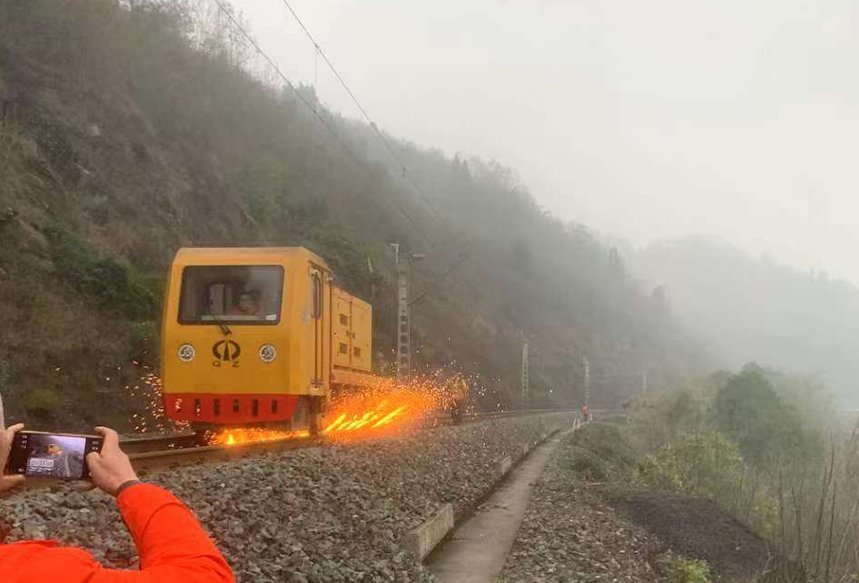
How does CNC intelligent copying improve rail profile grinding?
CNC intelligent copying improves rail profile grinding by replacing the operator's hand and eye with a stored, digital target profile. The controller holds the designed rail geometry, then automatically drives the grinding head along that profile in controlled passes — the same way every time. The result is consistent material removal pass after pass, no localised over-grinding, and a reprofile that lands on tolerance, which matters most where the geometry is complex and the rail is expensive: frogs, switch rails and crossing areas.
How a CNC copying machine works, step by step
- Measure the current profile — the actual rail head geometry is measured (miniprof or equivalent) and the deviation from target is quantified for each zone: inner rail zone, outer rail zone and crown.
- Load or generate the target profile — the designed geometry is loaded into the controller, together with the permitted grinding depth for the pass.
- Grind in controlled passes — the machine drives the grinding head along the stored profile itself, regulating feed per pass instead of letting an operator chase the low spots. Feed accuracy on this machine class is ≤0.10 mm, with constant spindle speed around 4500 rpm.
- Re-measure to verify — the achieved profile is compared with the target; if the deviation is inside the accepted envelope the job closes, if not the controller runs another pass.
Manual grinding vs CNC intelligent copying
| Aspect | Manual grinding | CNC intelligent copying |
|---|---|---|
| Profile reference | Operator experience and visual judgement | Stored digital target profile |
| Consistency | Varies with fatigue and technique | Identical every pass, reproducible |
| Over-grinding risk | High — localised deep grooves are common | Metre-by-metre feed limits protect the rail |
| Best suited to | Simple levelling and rough work | Frogs, switch rails and high-precision profile recovery |
| Typical accuracy | Depends on the operator | ≤±0.1 mm on machine class, ≤±0.2 mm on the grinding vehicle class |
The copying range covers P43 to P75 kg/m rail sections, so the same machine family serves conventional, heavy-haul and high-speed profiles. RailwayCare builds this capability into the RCG-C65 CNC intelligent copying rail grinder, one of a family that runs from lithium turnout grinders to the GMC16A grinding train.
Why it matters: turnout geometry and measured results
In a turnout, the frog and switch rail carry impact loads that accelerate wear the moment the geometry drifts; that is exactly where manual grinding is least repeatable and where CNC copying pays for itself. Profile control is verified against measurable limits — a 1 m straightedge deviation of ≤0.3 mm, surface finish Ra ≤10 μm and no blueing — with grinding depth capped at about 0.5 mm per pass. In measured campaigns with Molaton wheels, the Hefei–Wuhan high-speed test (2020) achieved 4.28 km·passes per mm against 3.27 for the reference wheel, a single wheel reaching 214.22 km·passes with no continuous blueing, and the Loram DM01 trial in 2026 recorded Ra of 1.05-9.0 μm (mostly 2-4 μm) with no blueing. Accuracy of that order only holds when the pass pattern is repeatable — which is the whole point of CNC copying. RailwayCare drafted the industry standard JB/T 11431 for rail grinding wheels and has been building these consumables since 2004.
Related questions you may also ask
What is a rail grinding machine and how does it work? What is the difference between a rail grinding wheel and a grinding stone? Rail profile grinding: techniques, standards and best practicesGet the profile ground right the first time
Send us your rail profile drawings, the defect pattern and your acceptance tolerance. We will recommend the matching CNC copying machine and the Molaton wheel set for your head geometry and rpm.
Request a Profile Grinding Plan