What is the difference between a rail grinding wheel and a grinding stone?
- Share
- Issue Time
- Sep 9,2026
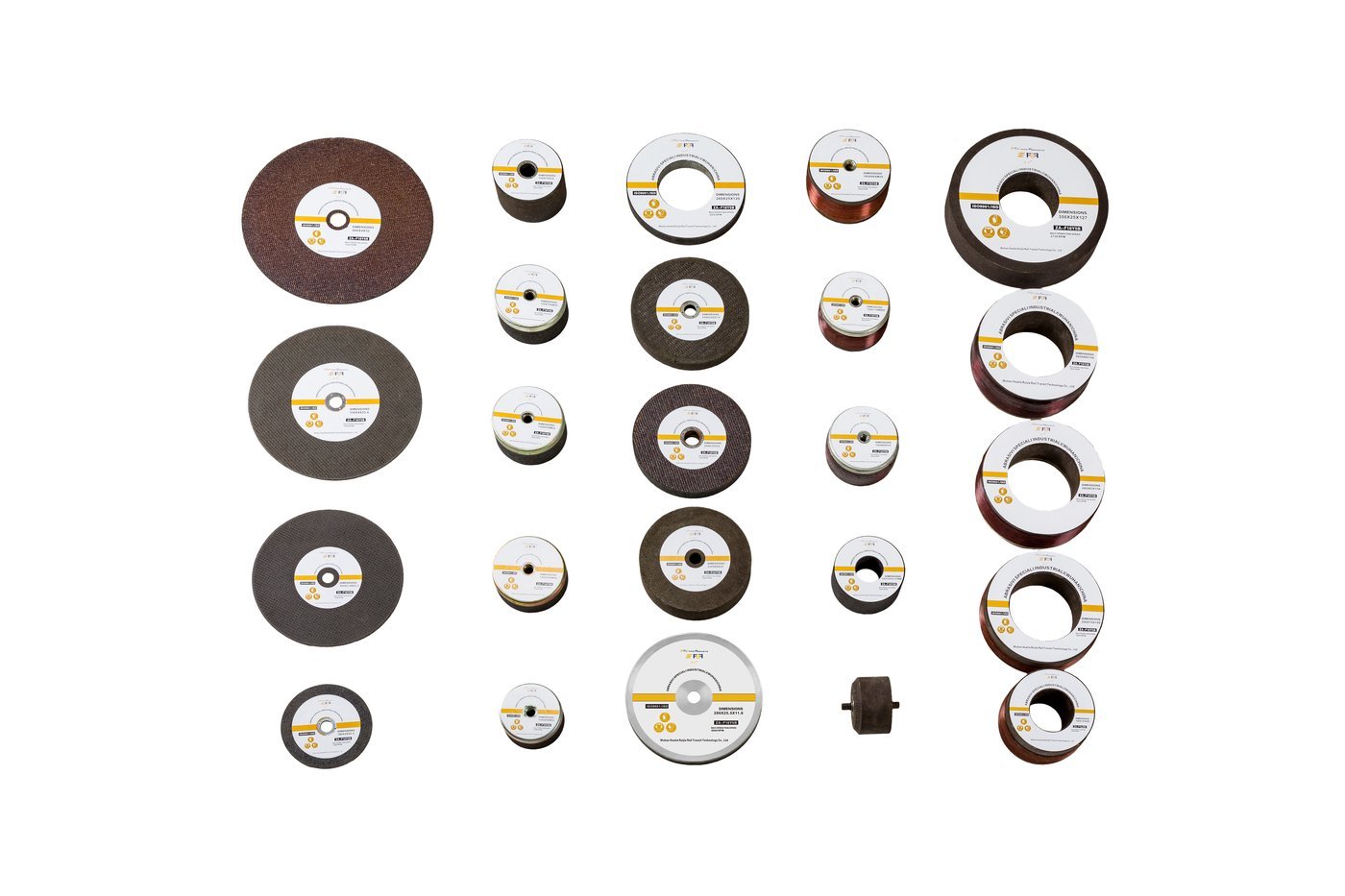
What is the difference between a rail grinding wheel and a grinding stone?
A rail grinding wheel is an engineered, precision-made disc — abrasive grain bonded with resin and reinforced with glass fibre, drilled with a true bore, balanced to ≤30 g and rated for 50 m/s — built to mount on a powered rail grinder. A grinding stone in the strict sense is a block-shaped abrasive used by hand or on low-speed tooling for light touch-up. If your job runs on a grinding train or a portable rail grinder — corrugation removal, profile restoration, weld finishing — you need a rail grinding wheel, not a stone.
Rail grinding wheel vs grinding stone at a glance
| Feature | Rail grinding wheel | Grinding stone (manual) |
|---|---|---|
| Form & mounting | Disc with a precision bore, clamped on a powered grinding head | Block or stick held by hand or simple tooling |
| Bond & reinforcement | Resin bond with glass-fibre reinforcement for impact loads | Typically vitrified or silicate, unreinforced |
| Speed rating | Minimum 50 m/s working speed per GB 2494; tested 4775 rpm for 30 s without rupture | Hand-speed only, no rating |
| Balance | Batch-balanced to ≤30 g per GB/T 2492 to prevent chatter and burning | Not applicable |
| Job | Corrugation removal, profile grinding and weld finishing to Ra ≤10 μm on live track | Light deburring, dressing and hand finishing |
| Governed by | Rail grinding wheel standards JB/T 11431, GB/T 2492 | General abrasive products only |
Which one does your rail job need?
Match the tool to the task in two steps. (1) Continuous or machine grinding — corrugation bands, worn rail head or profile defects over long sections are done with wheels mounted on grinding trains or portables: pick the exact size and bore for the head (e.g. 260x90x154 mm for PGM-48/96C-class trains, 150x70xM20 for Molaton MRC-S handheld grinders) with a minimum 50 m/s rating and batch balance. (2) Manual spot touch-up — a small hand stone may be acceptable for a few burrs at a weld, but it cannot hold profile tolerance.
Beware that many suppliers loosely call any abrasive a "rail grinding stone". Check the bore, speed rating, balance and the standard it is made to before buying. Molaton, the product brand of RailwayCare, has manufactured rail grinding wheels since 2004 — China's first dedicated producer, born from the friction-materials laboratory of Wuhan University of Technology. We drafted standard JB/T 11431 for rail grinding wheels and hold ISO 9001 / ISO 45001 / CRCC certification, so what we call a wheel is a wheel by standard. Browse the full railway grinding wheel range and the rail grinding machines they fit.
Field evidence — the engineered wheel wins on track
The difference shows in measured results. On the Liuzhou GMC-96X campaign (2022), Molaton wheels ground 18.72 km·passes in a 2-hour night window with 20-30 mm of wheel wear versus 43.5-59 mm for the imported reference wheel — about twice the durability. On the Yiyang line and Shuohuang heavy-haul railway, the fleet averaged 5.7 and 4.98 km·passes per mm of wear, holding surface finish to Ra ≤10 μm with no burning. A hand stone on the same defects would take far more passes and still miss the profile tolerance of ≤0.3 mm over a 1 m straightedge.
Related questions you may also ask
What is a railway grinding wheel and how does it work? How to choose the right rail grinding wheel for your equipment?Stop guessing between "stone" and "wheel" — get the engineered answer
Send us your grinder model, the defect you are fixing, and a photo of the abrasive you use today. Our engineers will confirm the exact Molaton wheel — size, bore, grit and bond — within 24 hours.
Get a Wheel Recommendation