Rail Grinding Cost per Kilometer: What Operators Pay
- Share
- publisher
- RailwayCare
- Issue Time
- Sep 4,2026
Summary
How much does rail grinding cost per kilometer? Real benchmarks, five cost drivers and field data showing how wheel choice cuts cost per pass-km by one third.
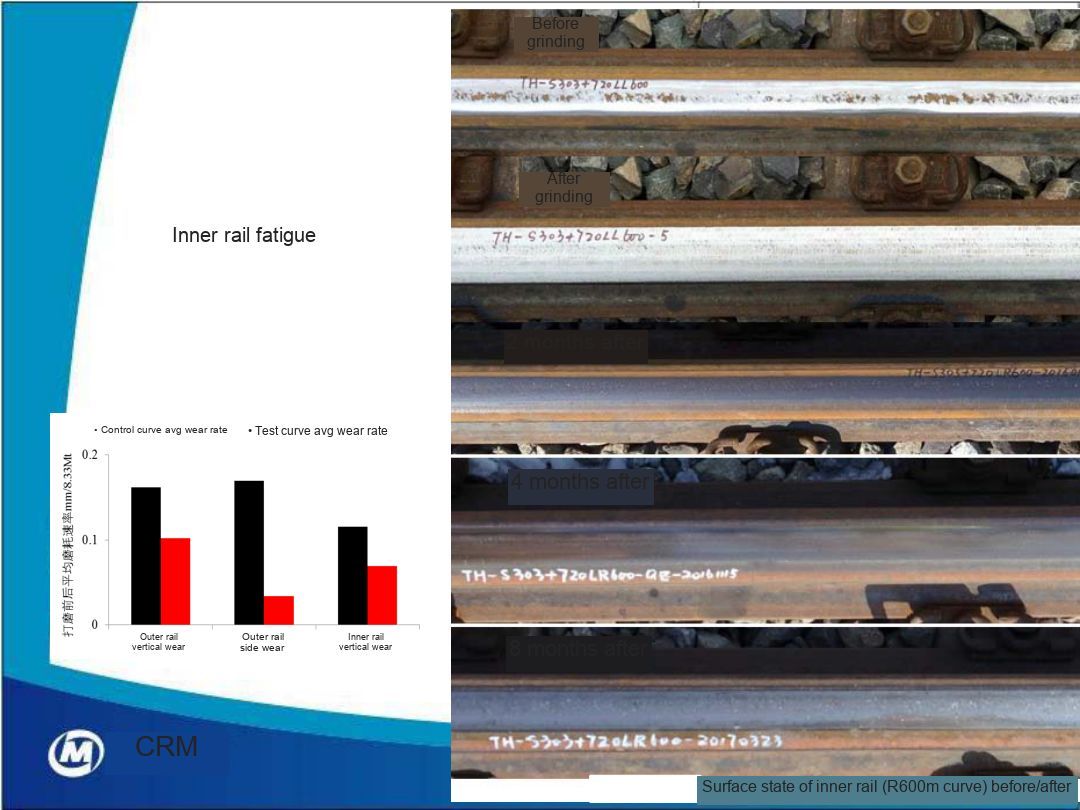
Rail grinding is not an expense line to be minimised blindly - it is a maintenance investment with a measurable return. Yet when the invoice arrives, many operators struggle to answer a simple question: what did this grinding actually cost per kilometer, and was it good value? The honest answer is that it depends entirely on how you measure it - and on the wheel doing the cutting. This guide breaks down rail grinding cost per kilometer into its real drivers, benchmarks what operators pay on different continents, and - using field data from high-speed, heavy-haul and metro projects - shows why the choice of grinding wheel can change the bill by a third or more. Published market research on rail grinding services (2026) puts contract grinding in the range of roughly USD 0.5-1.5 per track-metre per pass - in other words about USD 500-1,500 per route-kilometre for a single grinding pass, depending on machine size, rail condition and region. On China's national network, where grinding is typically tendered by the track maintenance bureau, 2026 public tenders priced machine grinding at RMB 4,750 per pass-km for a 48-stone grinding train and RMB 9,500 per pass-km for a 96-stone train (roughly USD 660-1,320), with equipment, maintenance, transport and consumables included. These are useful reference points - but the figure that matters on your budget is your own cost per kilometre, which is driven by five factors below. Note: the benchmarks above are directional. Your real cost per km depends on rail type (60 kg/m vs 75 kg/m), defect severity, grinding strategy, night-window availability and local labour rates. The single most useful metric for comparing grinding costs is not the wheel price tag - it is the cost per pass-kilometre. One pass-km equals one grinding pass over one kilometre of track. If a wheel costs the same but lasts 1.5 times longer, your wheel cost per pass-km falls by one third; if it lasts twice as long, it halves. That is exactly what field trials in China have measured. In laboratory simulation (7 km/h work speed, 8 kW power), typical imported and conventional wheels delivered 50-60 pass-km per wheel, while super-hard composite wheels delivered 100-150 pass-km - a 1.5-2× difference. On the Liuzhou GMC-96X half-train comparison, Molaton composite wheels lasted 1.5 times longer than the Norton wheel fitted on the other half of the same train. Wheel wear expressed per millimetre is equally telling: on the Hefei-Wuhan high-speed line, Molaton wheels achieved 4.28 pass-km per mm of wheel wear versus 3.27 for the incumbent wheel - an average of 214 pass-km per wheel, 1.31 times the service life. On heavy-haul lines the numbers were 4.98 pass-km/mm over 172.8 pass-km (Shuohuang) and 5.7 pass-km/mm over 145 pass-km (Yiyang). Cost per kilometre does not depend only on wheel life - it depends on how many passes the train must run to clear the defects. In the Liuzhou tests, a conventional wheel needed 4-6 passes to remove typical damage; the super-hard composite wheel cleared the same damage in 2-3 passes. Halving the number of passes nearly halves the machine, energy and possession-time component of your cost per kilometre - and it is the difference between finishing inside one night window or coming back a second night. In the same Liuzhou programme, 18.72 pass-km were ground inside a two-hour night window on the Hengliu line, which shows what efficient wheels make possible under real traffic constraints. Preventive grinding keeps the rail in its designed profile by removing only 0.1-0.2 mm before defects develop. Corrective grinding removes deep metal after corrugation, spalling or side wear has already appeared - and by then the rail has also been suffering accelerated wear in between. A small-radius curve case makes the arithmetic concrete: before corrective profile grinding, side wear on the curve grew at 12.556 mm per year; after grinding to a designed profile it fell to 0.85 mm per year - a 93% reduction (Fig. 1). Against a background where rail replacement typically costs USD 500-2,000 per metre (2026 market research), every year of service life saved by a grinding programme is worth far more than the grinding itself. Grinding wheels are the controllable heart of grinding cost. Molaton wheels are engineered around three levers that show up directly in your cost per kilometre: These results come from independent and side-by-side tests: the China Academy of Railway Sciences verified that wheel wear exceeded the Q/CR 1-2014 technical requirement by 1.4-2.6 times, and rotary safety testing passed 6,354 r/min without fracture. Molaton wheels are zirconia-alumina and super-hard composite wheels, resin-bonded with glass-fibre wrapping, rated 50 m/s, and matched to PGM-48/96C, RGH20C, Speno GMC16A/96B, Loram and Geismar/Robel machines. Contract rail grinding typically costs roughly USD 500-1,500 per route-kilometre per pass (about USD 0.5-1.5 per metre), depending on machine, rail condition and region. On China's network, 2026 tenders priced machine grinding at RMB 4,750 per pass-km for a 48-stone train and RMB 9,500 for a 96-stone train, equipment and consumables included. Preventive grinding costs less per kilometre than corrective grinding because it removes less metal in fewer passes. A pass-km is one grinding pass over one kilometre of track. It is the fairest unit for comparing costs because it links machine time, energy and wheel wear to the actual work done. Wheel life is normally quoted in pass-km per wheel or pass-km per mm of wheel wear. Abrasive type, bond system and safety rating drive the price. Premium zirconia-alumina and super-hard composite wheels cost more per piece but last longer and clear defects in fewer passes. The right comparison is cost per pass-km: a wheel that lasts 1.5 times longer cuts wheel cost per pass-km by one third even at a similar piece price. Yes, by a wide margin. Preventive grinding removes only 0.1-0.2 mm before defects form. Corrective grinding removes much more metal after corrugation, cracks or side wear appear, needs more passes, occupies more night windows and cannot recover the rail life already lost. In one curve case, profile grinding cut side wear from 12.556 mm/year to 0.85 mm/year - a 93% reduction that directly extends rail life. Run preventive cycles instead of corrective campaigns; measure supplier performance in pass-km per wheel rather than piece price; match the wheel to the machine and rail; enforce acceptance standards the first time to avoid rework; and choose a supplier that publishes third-party test and field data, such as RailwayCare's Molaton wheels. The cheapest grinding is the grinding you do not have to repeat - and the most expensive is the rail you replace early because maintenance was deferred. Measure your programme in cost per pass-km, grind preventively, and choose wheels whose field data you can check. That combination is what delivered a 1.5× wheel life, 2-3 pass defect removal and a 93% cut in curve side wear in the projects above. Tell us your rail type, machine model, curve distribution and annual tonnage - our engineers will recommend the right Molaton wheel specification and help you build a preventive grinding programme with a cost model you can defend. Whether you need rail grinding wheels for grinding trains, switch grinders or hand machines, want a quotation, or need help estimating your rail grinding cost per kilometer, our engineers are ready to help. Reach us by any channel below: RailwayCare (Wuhan Huatie Ruijie Rail Transit Technology Co., Ltd.) – your professional partner in rail grinding, with Molaton grinding wheels field-proven on high-speed, heavy-haul and metro lines since 2004.What Operators Actually Pay per Kilometer
The Five Drivers Behind Every Cost per Kilometer
Measure It Right: Wheel Cost per Pass-Kilometre
Fewer Passes, Lower Bill: the 2-3 vs 4-6 Story
Preventive Grinding Is the Cheapest Kilometer You Will Ever Grind
Why the Wheel Choice Can Move Your Bill by a Third
Five Ways to Cut Your Rail Grinding Cost per Kilometer
FAQ - Rail Grinding Cost
How much does rail grinding cost per kilometer?
What is a pass-km and why does it matter for cost?
Why do rail grinding wheel prices vary so much?
Is preventive rail grinding cheaper than corrective grinding?
How can operators reduce rail grinding cost?
Final Thoughts
Contact RailwayCare