Rail Corrugation: A Comprehensive Analysis of Causes, Impacts, and Precision Grinding Solutions
- Share
- Issue Time
- Apr 14,2026
Summary
Rail corrugation is a common and complex defect in railway operations, characterized by periodic wave-like irregularities on the rail surface. This article delves into its formation mechanisms, classifications, and associated risks.
Rail corrugation, defined as the periodic uneven plastic deformation and wear along the longitudinal axis of the rail head running surface, is one of the most common and complex forms of rail damage. Its hallmark is a wave-like undulation where troughs exhibit severe plastic deformation, leading to a widened running band, while crests, with minimal deformation, show a narrower band. This regular irregularity is not only a sign of deteriorating track condition but also a major threat to operational safety and ride comfort.
Multidimensional Causes: From Macro Theories to Micro Mechanisms
The formation mechanism of corrugation is rooted in the dynamic interplay between wheel and rail. Traditionally, it can be attributed to three macro-level theories: frictional self-excited vibration, feedback vibration, and contact fatigue. However, modern wheel-rail dynamics research, through frequency analysis, has precisely linked these macro phenomena to specific system resonance modes, identifying three main types of corrugation.
Type 1: P2 Force Resonance
● Characteristic Frequency: Below 100 Hz.
● Formation Mechanism: Caused by the P2 resonance of the wheel-rail system, where the unsprung mass (wheelset) bounces vertically on the track's support stiffness. When a vehicle passes over an initial irregularity, this resonance is excited, causing a periodic fluctuation in vertical wheel-rail forces, which then exacerbates corrugation growth through a feedback mechanism.
● Key Parameters: Primarily influenced by unsprung mass and track support stiffness. This typically corresponds to long-pitch corrugation on mixed-traffic lines.
Type 2: Wheelset Secondary Torsional Mode Dominated (Most Common & Challenging)
● Characteristic Frequency: Around 300-350 Hz (corresponding to a wavelength of approximately 25-100mm, with 50mm being most common).
● Formation Mechanism: This is the core finding of current research! The corrugation frequency aligns closely with the secondary torsional mode of a powered wheelset (with a drive gear). In this mode, the two wheels twist in the same direction, while the central drive gear twists in the opposite direction. When one wheel (e.g., the right wheel) encounters a minor irregularity, it excites a torsional vibration of the entire wheelset. This vibration is transmitted via the axle to the other wheel (the left wheel), causing its rotational speed to fluctuate. Crucially, even if the rail under the left wheel is perfectly smooth, this speed fluctuation—originating from the opposite rail—will cause variations in creepage, thereby "engraving" corrugation onto the previously smooth rail. This mechanism explains why corrugation is often observed on rails far from joints or obvious irregularities.
● Key Triggers: Frequent train traction, braking (which generate longitudinal forces), and curve negotiation are the primary external conditions that excite this type of corrugation. This mechanism, driven by longitudinal creepage fluctuations, is the principal "culprit" behind short-pitch corrugation on metros and high-speed railways.
Type 3: Track Pinned-Pinned Resonance
● Characteristic Frequency: Above 600-800 Hz.
● Formation Mechanism: The excitation frequency matches the pinned-pinned (between fastener points) resonance frequency of the track. In this resonance, the rail undergoes high-frequency bending vibrations with the fasteners as nodal points, leading to uneven material wear on the rail surface.
● Key Parameters: Primarily influenced by fastener spacing and rail linear density.
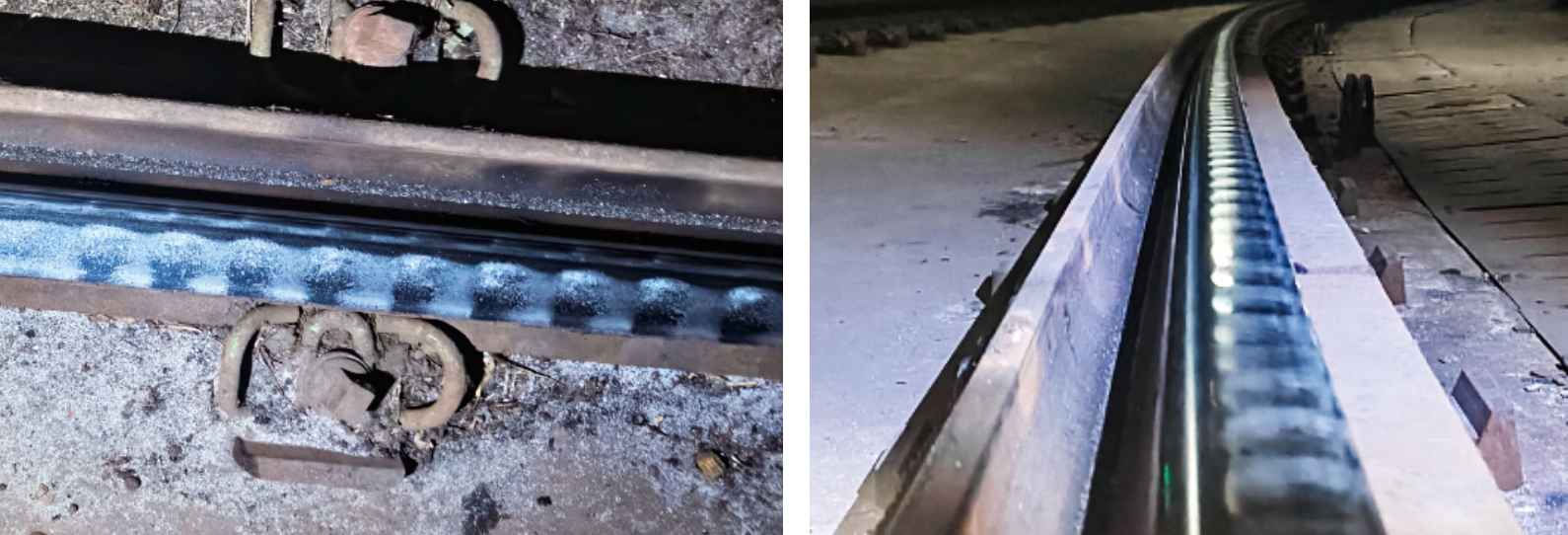
Additionally, unique corrugation patterns can emerge in special track structures, such as "scalloped" corrugation related to lateral forces on small-radius curves with guard rails, or distinctive corrugation in sections with resilient boot sleepers due to the introduction of new, low-damping system resonances.
Corrugation Characteristics Across Different Railway Types
The specific form of corrugation is closely tied to operational conditions:

● Metro Lines: Characterized by light axle loads, numerous small-radius curves, and short station intervals, requiring frequent acceleration and braking. This results in short-pitch (30-80mm), shallow corrugation that generates high-frequency vibrations (>200Hz), significantly impacting passenger comfort. This is the typical domain of Type 2 (Wheelset Torsional Mode) corrugation.
● Mixed-Traffic Railways: Heavy-haul trains cause long-pitch (200-300mm), deep corrugation with low-frequency vibrations (~30Hz), primarily threatening track structural integrity. This is often associated with Type 1 (P2 Force Resonance).
● High-Speed Railways: Corrugation shows no strong preference for alignment type, appearing non-contiguously (each section ~10-15m long) on tangents, transition, and circular curves. Its wavelength ranges from 60-150mm, with a shallow depth (0.04-0.10mm), but poses critical challenges to the stringent smoothness and safety requirements of high-speed operations. Corrugation on high-speed lines is also predominantly driven by the Type 2 mechanism.
● Turnout Areas: Manufacturing and installation deviations are amplified under train loads, making turnouts highly prone to corrugation. Wavelengths of 80-300mm are common on the curved leg; 300-1000mm corrugation can occur throughout the entire turnout; and ultra-long wavelengths of 1000-2500mm often originate from initial rolling imperfections in the rail.
Extensive Impacts: A Cascading Effect from Track to Train
The hazards of corrugation are systemic and far-reaching:
● Damage to Track Structure:
Damage to Track Structure:
- Accelerated Ballast Degradation: Vertical impacts crush the ballast.
- Induced Voiding and Mud Pumping: Voided sleepers cause white sub-ballast to appear on the surface, and prolonged voiding combined with water leads to mud pumping.
- Induced Voiding and Mud Pumping: Voided sleepers cause white sub-ballast to appear on the surface, and prolonged voiding combined with water leads to mud pumping.
● Impacts on Train Operations:
● Deteriorated Wheel-Rail Adhesion: Surface irregularities reduce the adhesion coefficient, increasing running resistance and power consumption, often forcing drivers to reduce speed.
● Higher Vehicle Maintenance Costs: Severe vibrations cause components to loosen or fracture, significantly increasing inspection and repair workload and costs.
● Compromised Operational Safety: On severely corrugated sections, the large impact force at crests and the instantaneous load reduction at troughs create a high risk of derailment.
This standard specifies the acceptable trough depth thresholds, measurement window lengths, and allowable exceedance rates for different wavelength bands. All measurements must be completed within 8 days after grinding or before the track accumulates 0.3 million gross tons (Mt) of traffic to ensure an accurate assessment of the immediate grinding outcome.
The RailwayCare Solution: A Reliable Choice for Tackling Corrugation
Facing the demanding requirements of rail corrugation management—high efficiency, high precision, and strong adaptability—the Molaton RailwayCare range of grinding wheels delivers outstanding performance. Leveraging a thermally stable resin bond and selected abrasive grains, these products consistently achieve high-quality grinding results across various corrugation conditions, from subtle short-pitch to severe long-pitch waves. They effectively restore rail surface smoothness and extend rail service life.
Get Your Customized Solution
Is your network plagued by persistent rail corrugation? Discover how the Molaton RailwayCare range of grinding wheels can empower your maintenance team to resolve corrugation issues definitively, using more scientific methods and efficient tools to ensure trains operate smoothly, quietly, and safely. [Contact us now for a tailored technical proposal].
📧 Contact us: mailto:RCInfo@railwaycare.com
🌐 Explore our turnout grinding system: www.railwaycare.com